

All about Warhammer 40k 11th edition: Rules, news and Armageddon box
Whether you are a veteran player who has been rolling dice for decades or a beginner who has just discovered this fascinating universe, you are probably eagerly awaiting the release date of Warhammer 40,000 11th edition. Fortunately, the wait is almost over: Games Workshop has set June 20, 2026, as the date for the major worldwide launch. As passionate hobbyists, we have analyzed all the official information published so far and the new features revealed by Games Workshop, and everything suggests that this edition represents a major evolutionary leap.
In this article, we are going to break down how the game is played, analyzing its phases, army structure, and new mechanics. The game has been redesigned to be more intuitive, but with a level of tactical depth that will force us to rethink all our strategies. Get ready, because Warhammer 40k 11th edition is going to change gaming tables forever.
The launch box: Warhammer 40k Armageddon
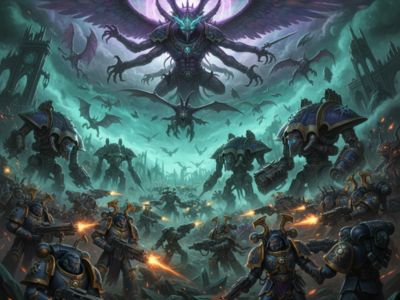
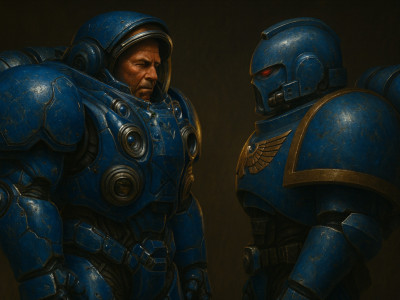
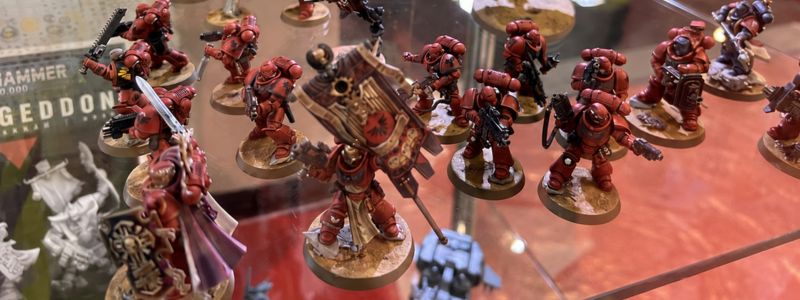
The starting signal for Warhammer 40k 11th edition comes with a launch box that has sent the entire community into a frenzy: the spectacular Warhammer 40k Armageddon. This set takes us back to one of the most iconic and war-torn worlds in the history of the Imperium. The cinematic trailer has already given us chills by showing the Blood Angels falling from the skies to face the endless hordes of Orks.
Playing across the ash wastes always brings back nostalgic memories, and fans of the lore and the Steel Legion of Armageddon will appreciate the return to this iconic conflict. This box not only includes incredible miniatures, but also comes with the core rulebook for Warhammer 40k 11th edition, the Chapter Approved mission deck, and the Dominatus narrative deck.
The command phase and the new Battleshock in Warhammer 40k 11th edition
The Command Phase has received adjustments that make morale much more critical. Now, the Battleshock test is taken when a unit is at half strength or below. In the previous edition, you had to be below half strength, which means that in this edition you will see many more units, especially 10-wound vehicles that drop to 5 wounds, having to take tests.
In addition, the big change is that if your unit was already Battle-shocked, it must test again to regroup. If it fails, the Battle-shock state persists, leaving the unit with an Objective Control (OC) characteristic of 0, now represented with a dash, and unable to be targeted by Stratagems. Morale in Warhammer 40k 11th edition can definitely ruin your primary objective control plans.
Movement and unit Coherency
The Movement Phase in Warhammer 40k 11th edition brings some much-needed quality-of-life changes. First, turning or pivoting miniatures on their own axis is now completely free for all models. In addition, miniatures can move through friendly miniatures freely, which makes repositioning much easier.
However, the most drastic positional change is unit coherency. Now, each miniature must be within 2" of another miniature from its unit and, at the same time, within 9" of every other miniature in that unit. Forget the infamous “conga lines” that stretched across half the table; units must now maintain a compact and logical formation. Engagement Range has also increased to 2" horizontally, allowing more miniatures to attack and making it harder to use the tactic of hiding exactly 1" behind a wall.
Shooting, Cover, and Terrain: The Revolution of Warhammer 40k 11th edition
If there is one phase that feels different in the latest edition, it is the Shooting Phase. Shooting types have now been formally classified as: Normal, Assault, Close Combat, for vehicles and pistols, and Indirect Fire.
Cover has undergone a complete redesign. It no longer grants a +1 to the saving throw; instead, the benefit of cover worsens the attacker’s Ballistic Skill (BS) by 1, acting as a -1 modifier to hit. This means that in Warhammer 40k 11th edition, troops with a strong base save do not become immortal just by stepping into a crater, but they will force the enemy to miss more shots.
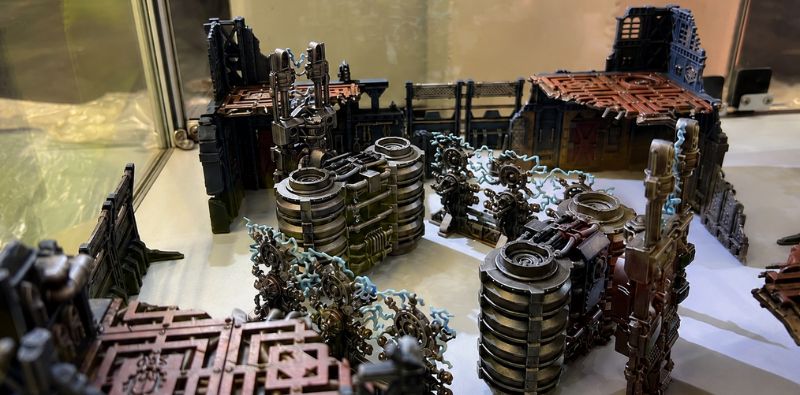
Terrain also introduces the Solid rule, which prevents lines of sight from being drawn through openings, such as windows or doors, in ruins that are 3" or less above ground level. But the crown jewel is the Hidden rule. This rule states that Infantry, Beasts, or Swarms inside Dense terrain that did not shoot in the previous turn cannot be seen or attacked by enemy units more than 15" away. This mechanic allows infantry to advance or hold objectives much more safely against long-range cannons.
Finally, Indirect Fire has been heavily penalized. If the attacking miniature fires at a target that is completely invisible to your entire army, hit rolls of 1 to 5 automatically fail, meaning you only hit on 6s, and the target receives cover. If at least one allied model “spots” the target, the penalty is reduced and rolls of 1 to 3 automatically fail instead. And be careful with Hazardous weapons; each failed Hazardous test, on a roll of 1 or 2, inflicts 1 mortal wound on the unit, or 3 mortal wounds if it is a Monster or Vehicle. Overcharging plasma is now twice as risky.
Charges and combat
Close combat fans have a lot to study in Warhammer 40k 11th edition. The Charge Phase solves one of the biggest problems from previous editions: you now roll the 2D6 charge distance FIRST, and then choose your targets within that maximum distance. This gives you brutal tactical flexibility; if you unexpectedly roll a 12, you can redirect your charge toward a distant tank instead of the screening unit in front of you.
The Fight Phase also changes the balance of power. The Fights First rule has been modified. Now, during the Fights First step, the active player, the player whose turn it is, chooses the first unit to fight, and then players alternate. This means that if you charge into a unit that naturally has Fights First, you will strike first, making charging no longer an automatic suicide move against certain elite units.
Consolidation moves have been formalized into three types: Continued Consolidation, if you remain engaged; Engagement Consolidation, to reach new units within 5"; and Objective Consolidation, to move toward a marker. In addition, there is now “Overrun Fight,” which allows units that have become unengaged because enemy casualties were removed to pile in an extra 3".
List building and characters: The flexibility of Warhammer 40k 11th edition
Army building gets a breath of fresh air. Characters are now formally divided into two categories: Leader and Support. You can attach up to one Leader and one Support to the same Bodyguard unit, allowing for fantastic combos, such as a Warboss and a Painboy in the same Ork unit.
Unlike the previous edition, in Warhammer 40k 11th edition, the Attached unit is considered a single entity in a stricter way. If the entire Bodyguard unit is destroyed and only the Character remains, that Character does not return to its starting strength; it counts as a damaged unit and will have to take Battleshock tests. However, the advantage in this edition is that the Character retains the buffs provided by its Bodyguard, until the Bodyguard is completely destroyed, and can even bring back Bodyguard miniatures with healing abilities, since it is considered the same unit.
Transports and the new disembarkation system
Transport vehicles are a central part of mobility, and in Warhammer 40k 11th edition, disembarking is more tactical than ever. There are three voluntary modes:
1. Rapid Disembarkation. If the Transport has made a Normal Move or an Arrival Move, you disembark within 3", but you cannot charge.
2. Tactical Disembarkation. If the Transport has not moved, you disembark within 3" and, once outside, the unit must make a Normal Move or an Advance Move. If you choose the Normal Move, you can charge as usual.
3. Combat Disembarkation. This is where we get something new: you disembark within 6" of the Transport, and may end up directly engaged in combat, but it requires a risk roll for each miniature, potentially causing mortal wounds, and the unit automatically becomes Battle-shocked and cannot declare a charge.
4. Emergency Disembarkation. If your Transport is destroyed, you are forced to disembark within 6", suffering risk rolls for each miniature and leaving your unit Battle-shocked. In addition, you must place the miniatures as close as possible to the destroyed Transport.
New Products Accompanying Warhammer 40k 11th Edition
To support this massive rulebook, Games Workshop will launch two essential products alongside Warhammer 40k 11th edition. On one hand, there is the Combat Patrol Companion, a 184-page book that will serve as the definitive guide to background lore and advice for playing the Combat Patrol format, ideal both for beginners and for veterans looking for fresh lore from the galaxy.
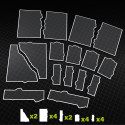
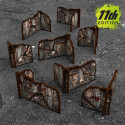
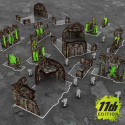
On the other hand, there is the Warhammer 40,000: Terrain Area Set. Since terrain footprints are vital for the cover, Solid, and Hidden rules, this set includes 16 double-sided cardboard templates in 5 standardized sizes. This ensures that, wherever you play, the size of the terrain bases is fair and balanced.
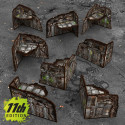
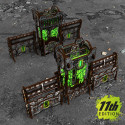
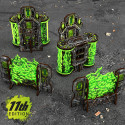
You can purchase additional scenery elements from specialized stores such as Green Stuff World, where we have developed footprints compatible with the 11th edition that you can complement with our resin bits, modeling vegetation, sand, or, if you need to paint your miniatures, with our huge catalog of model paints.
As you can see, Warhammer 40k 11th edition is not a simple patch. It is a meticulous reconstruction designed to make the game more tactical, reduce abuses from past rules, and give greater importance to positioning and intelligent terrain control. The change to charge resolution, the powerful Hidden rule, and the new Character mechanics make every game a top-tier tactical puzzle. See you on the battlefields. May the Emperor protect, or may the Waaagh! sweep everything away!
Legal Notice
All trademarks, logos, and product names mentioned, including but not limited to Warhammer 40k, Warhammer 40k Armageddon, and any other titles, are the property of their respective owners. The use of these names in this text is for informational and descriptive purposes only, with no intention of infringing intellectual property rights, copyrights, or registered trademarks.
This content is not sponsored, authorized, endorsed by, or affiliated with any of the owners of the trademarks mentioned, nor does it imply any commercial relationship with them. Any reference is made solely to facilitate the reader’s understanding within the context of informational content for miniature wargaming enthusiasts.
Furthermore, Green Stuff World is not associated with, licensed by, affiliated with, or authorized by the creators or owners of Warhammer or any other trademark mentioned. The mention of Green Stuff World is provided solely as an example of a general supplier of accessories and materials for modeling and wargames.
This text is provided for informational purposes only and is not intended to replace, replicate, or compete with the official products or services of any registered trademark.
Share this content