


Bolt Action for beginners: complete guide to start playing
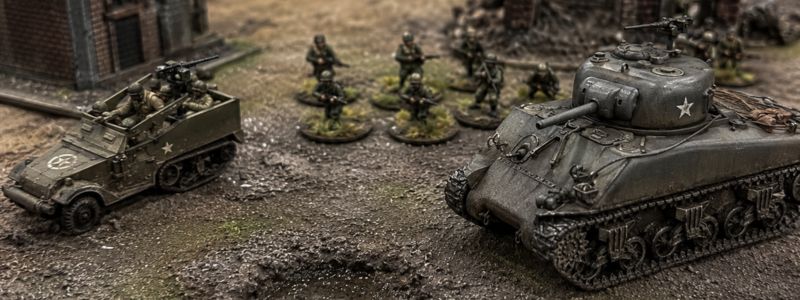
Bolt Action is a dynamic 28 mm tabletop miniature wargame set during the global conflict of the Second World War. Created by industry veterans and published by Warlord Games in collaboration with Osprey Publishing, the game allows players to recreate historical battles or take part in hypothetical skirmishes using highly detailed miniature soldiers and vehicles. The rules are currently in their Third Edition, which has streamlined gameplay, updated force composition, and refined the general combat mechanics.
The main focus of the game is platoon-level infantry combat, which means that players command squads of riflemen, soldiers armed with submachine guns, and support teams, instead of commanding entire divisions in an abstract way. Although infantry is the core of any force, the game integrates tanks, armored vehicles, and heavy artillery to create a complete battlefield experience. Standard games are usually played at 1,000 or 1,250 points, which generally takes between two hours and two and a half hours of play. The points system ensures that battles remain balanced, allowing players to deploy historically accurate forces or customized tactical lists.
The basic mechanics: order dice and pin markers
The hallmark of the system is its unique activation mechanic. Unlike traditional wargames, in which one player moves their entire army before the other player responds, this game uses an order dice system. Each unit in a player’s army generates one order die; these dice are placed in a single opaque bag together with the opponent’s dice. A die is drawn at random from the bag, and the player whose color has been drawn may activate one unit of their choice. This creates an unpredictable atmosphere of fog of war, where you can never guarantee who will take the initiative next.
When a unit is activated, it must be assigned one of six specific orders. The chosen order determines the unit’s capabilities during that turn:
• Fire: the unit remains stationary and fires its weapons at full effectiveness.
• Advance: the unit may move up to 6 inches, in the case of standard infantry, and then fire its weapons, suffering a -1 penalty to accuracy for firing on the move.
• Run: the unit moves at double speed, 12 inches for infantry, without firing, allowing it to reposition quickly or launch an assault at close range.
• Ambush: the unit does not move or fire immediately; instead, it waits to make opportunity fire if an enemy unit moves within its line of sight later during the turn.
• Rally: the unit gives up its movement and shooting to recover its morale, removing all accumulated pin markers after passing a morale test.
• Down: the unit hits the ground, giving up movement and shooting, but gaining a significant defensive bonus, +2 to cover saves, against incoming fire.
Just as important as the activation system is the concept of pin markers. Every time a unit is shot at and suffers at least one hit, even if no casualties are caused, it receives a pin marker. These markers represent the psychological stress and suppression of combat. Each pin marker imposes a -1 penalty on the unit’s rolls to hit when it fires and a -1 penalty to its morale value when it takes an order test. If a unit attempts to execute an order while pinned, it must pass an order test by rolling 2D6 under its modified morale value. Rolling double 6 causes a “FUBAR”, Fucked Up Beyond All Recognition, a catastrophic failure that may cause the unit to panic and flee, or even open fire on friendly troops.
Troop quality and infantry combat
Armies are built around the quality of their troops, which determines their base morale and survivability. Inexperienced troops represent recruits or militia; they are cheap to deploy, but have a base morale of 8 and die on a damage roll of 3+. Regular troops represent standard trained soldiers, with morale 9, and die on a 4+. Veteran troops are elite fighters with a base morale of 10 and are exceptionally resilient, as they require a 5+ to be eliminated.
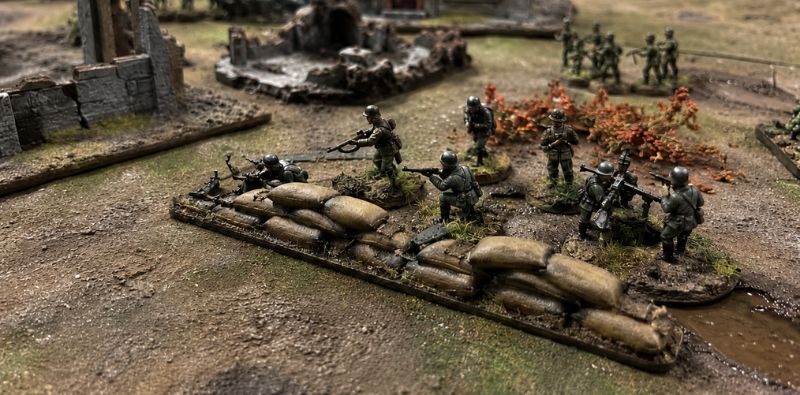
Shooting is resolved by following a specific sequence: declare a target, target reaction, such as going “Down”, measure range, roll to hit, roll to damage, the target’s cover saves, remove casualties, and finally check morale. The base roll to hit an enemy is 4+ on a six-sided die, modified by factors such as point-blank range (+2), firing on the move (-1), or having pin markers (-1). If a unit is successfully damaged, it may attempt a cover save; light cover provides a 5+ save, while heavy cover saves on a 4+.
Choosing your first forces: the Bolt Action starter set
For new players, the most accessible way to enter the hobby is to buy a Bolt Action starter set. These core boxes contain absolutely everything two players need to learn the game, including the core rulebook, order dice, standard six-sided dice, pin markers, blast templates, and a measuring tape in inches.
The main Third Edition starter is “Band of Brothers”, which pits US Airborne troops against German Grenadiers during the D-Day campaigns. This box includes 12 US Airborne infantry miniatures, 12 German Grenadiers, an M3A1 half-track, an Sd.Kfz 251/1 half-track, and ruined farmhouse scenery. Another excellent entry point is the “Battle of the Bulge” starter set, which includes US Army infantry equipped for winter facing German Fallschirmjäger in winter gear, supported by an M8 armored car and ruined farmhouse terrain.
For those interested in other theaters of war, Warlord Games also offers starter sets such as “A Gentleman’s War”, focused on the desert campaigns of North Africa, and “Island Assault”, which recreates the brutal clashes of the Pacific theater between the United States Marine Corps and the Imperial Japanese Army. Starting with one of these boxes guarantees a balanced and self-contained experience before expanding into larger battles.
Expanding the battlefield: Bolt Action starter armies
Once players have understood the basic rules, the next logical step is to acquire Bolt Action starter armies. These complete boxes are specifically designed to provide a highly cost-effective army that is ready to play once assembled, reaching the standard threshold of 1,000 to 1,250 points straight from the box. A standard starter army usually includes around 36 infantry miniatures, one or two armored vehicles, heavy support weapons such as machine guns, and an artillery piece.
Players can choose between the major powers of the conflict: the disciplined German Wehrmacht or the Waffen-SS, the huge ranks of the Soviet Union, the highly mechanized United States Army, the resilient British Commonwealth, or the fierce Imperial Japanese Army. The game also offers strong support for minor nations, allowing players to deploy forces from Italy, France, Poland, Finland, and Romania. Players interested in the Asian theater of operations can even create forces representing Bolt Action China, using Chinese troops to recreate the Second Sino-Japanese War or expanding the experience with the later Bolt Action: Korea ruleset.
Common starter armies and their play styles: table
| Faction and box name | Typical box contents | Play style focus |
| US Army Starter Army | 36 infantry miniatures, Sherman tank, M3A1 half-track, 105 mm artillery, medium mortar, and 3 medium machine gun teams. | High mobility, superior firepower thanks to additional rifle shots, and excellent Bolt Action combined arms support. |
| German Grenadiers | 36 infantry miniatures, StuG assault gun, Puma armored car, anti-tank gun, mortar, and medium machine gun. | Tactical flexibility, access to large volumes of automatic weapons, such as assault rifles and submachine guns, and elite armor. |
| Imperial Japanese | 42 infantry miniatures, Chi-Ha tank, Ho-Ro assault gun, and Type 91 howitzer. | Aggressive close-range assaults, fanatical morale rules, and cost-effective light armor. |
| British & Canadian (Winter) | Infantry squads, support teams, transport vehicles, and Universal Carriers, with the exact contents varying depending on the specific period. | Resilient infantry, free artillery bombardments, and specialized national characteristics. |
List building and the search for Bolt Action Easy Army
To move from a random collection of miniatures to a legal fighting force, players must organize their troops into platoons. A standard reinforced platoon requires a core of at least one officer, a lieutenant, and two infantry squads. From there, players can allocate points to add machine gun teams, snipers, mortars, artillery pieces, and armored vehicles. The specific points and organizational structures are detailed in the main rulebook and in the different “Armies of...” supplement books.
Because calculating points and weapon upgrades by hand can become tedious, modern wargamers often use digital list-building tools. When designing a new list, players often turn to search engines to find a Bolt Action Easy Army tool. Finding a reliable Easy Army Bolt Action resource allows players to quickly choose their theater selector, automatically calculate costs according to troop quality, and make sure their platoons meet all legal requirements.
Note: although the official point values are provided strictly in the rulebooks and supplements published by Warlord Games, these community-driven digital tools are external resources widely adopted by the player base for tournament preparation and casual games.
Mastering a Bolt Action combined arms approach
Success on the tabletop requires more than pushing infantry forward; it demands a complete Bolt Action combined arms strategy. No single type of unit can win the game by itself. Infantry is essential because only infantry units can capture and hold the objectives needed to win most scenarios. However, infantry without support will quickly fall to enemy machine guns and artillery.
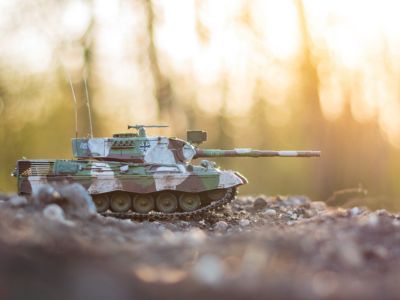
Vehicles and tanks provide mobile fire support and are essential for neutralizing enemy armor. Armored targets are difficult to destroy with small arms; a light tank requires an armor penetration roll of 8+, a medium tank requires a 9+, and heavy tanks require a 10+. To counter them, a combined arms force must include anti-tank guns, bazookas, or Panzerfausts. Tanks also carry coaxial and hull-mounted machine guns, which are excellent for suppressing enemy troops.
Artillery and indirect fire weapons, such as mortars and howitzers, form the final pillar of this triad. These weapons use high-explosive rules, HE, firing blast templates ranging from 1 to 4 inches in diameter. HE weapons ignore standard cover modifiers, which makes them perfect for dislodging entrenched enemies hidden in buildings or bunkers. In addition, artillery can deploy smoke screens to block enemy lines of sight, providing safe passage for your advancing infantry. Synchronizing your infantry, armor, and artillery is the key to dominating the battlefield.
Hobby, scenery, and 3D printed Bolt Action models
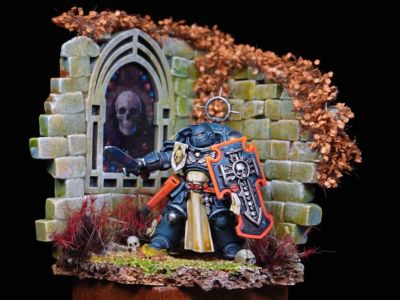
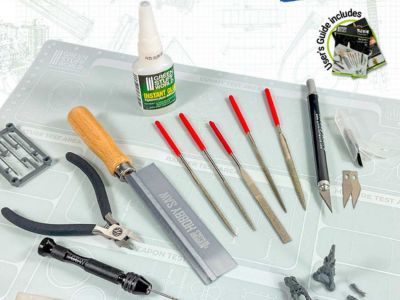
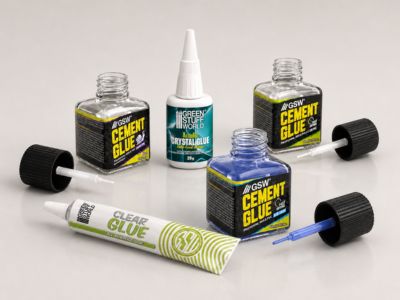
Beyond tactical gameplay, Bolt Action is a deeply rewarding modeling and painting hobby. The miniatures are supplied unassembled and unpainted, made from hard plastic, metal, or highly detailed resin. Players use plastic glue, hobby knives, and acrylic paints to bring their armies to life, often researching historical camouflage patterns and uniform colors to ensure authenticity.
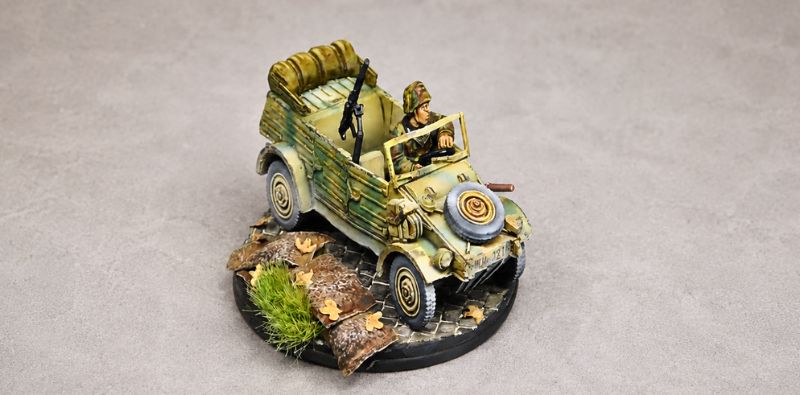
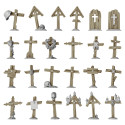
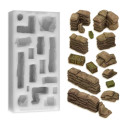
The battlefield itself is a canvas. Although starter sets provide basic plastic ruins, a visually spectacular game requires forests, roads, ruined towns, and trench lines. To populate their tables with high-quality and cost-effective scenery, many players use 3D-printed resin bits. 3D printing has revolutionized the hobby, allowing players to print very specific historical buildings, unique objective markers, or even rare prototype vehicles that are not manufactured in plastic. Whether buying official MDF scenery kits or printing custom files at home, building an immersive table is half the fun of the wargaming experience.
Therefore, Bolt Action remains one of the most accessible, engaging, and tactically rewarding historical wargames on the market today. By starting with a core box, understanding the unique order dice mechanics, and learning how to create synergies between your infantry and heavy support, any beginner can quickly become a formidable commander on the battlefield.
Legal Notice
All trademarks, logos, and product names mentioned, including but not limited to Bolt Action and any other titles, are the property of their respective owners. The use of these names in this text is for informational and descriptive purposes only, with no intention of infringing intellectual property rights, copyrights, or registered trademarks.
This content is not sponsored, authorized, endorsed by, or affiliated with any of the owners of the trademarks mentioned, nor does it imply any commercial relationship with them. Any reference is made solely to facilitate the reader’s understanding within the context of informational content for miniature wargaming enthusiasts.
Furthermore, Green Stuff World is not associated with, licensed by, affiliated with, or authorized by the creators or owners of Bolt Action or any other trademark mentioned. The mention of Green Stuff World is provided solely as an example of a general supplier of accessories and materials for modeling and wargames.
This text is provided for informational purposes only and is not intended to replace, replicate, or compete with the official products or services of any registered trademark.
Share this content