


Star Wars: Legion: what it is and how to start playing in 2026
Welcome to the ultimate guide to diving into one of the most immersive miniature wargames on the market. If you are a hobby enthusiast or you are passionate about tactical games and want to command iconic forces on the tabletop, this complete analysis will give you everything you need to know to get started.
In this game, players build, paint, and lead entire armies from the different factions of the galaxy, bringing highly detailed miniatures to life. Whether you want to recreate legendary cinematic moments or you prefer to create your own Tours of Duty, this guide gives you all the information you need.
Origin of Star Wars: Legion
Star Wars: Legion was originally released in 2018 under the Fantasy Flight Games label, focused on the era of the Galactic Civil War between the Empire and the Rebellion. As the game gained popularity, its scope expanded in 2019 to include the Clone Wars era, adding the Galactic Republic and the Separatist Alliance.
Today, the game is developed by Atomic Mass Games and published under the Asmodee North America umbrella. The transition to Atomic Mass Games has brought continuous updates to the game, including a complete second edition ruleset, Legion 2.0, published to refine gameplay mechanics, clarify interactions between keywords, and introduce updated point values for units. Today, players can download these updated core rules for free directly from the official Atomic Mass Games website, which helps keep both the competitive and casual scenes balanced and accessible.
Factions, battle forces, and unit types
Before buying miniatures, you need to decide which faction you want to start with. Star Wars: Legion is divided into Light Side and Dark Side alignments, with four main factions: the Galactic Empire, the Rebel Alliance, the Galactic Republic, and the Separatist Alliance.
In addition to the main factions, players can hire mercenaries. These forces include organizations known as the Black Sun, the Pyke Syndicate, raiders, renegades, and several Mandalorian clans, such as Clan Kryze and Clan Wren. Mercenaries do not belong to the standard factions, but certain factions can hire them to reinforce their armies.
When building your forces, you will command a wide variety of troopers from Star Wars, along with powerful commanders, agents/operatives, corps units, special forces, support units, and heavy units. The game classifies infantry into several distinct subtypes, each with unique rules. You will be able to deploy basic trooper units, heavy troopers, and specialized units such as clone troopers, battle droids, creatures, emplacement troopers, Wookiees, and Mandalorians. For example, clone troopers benefit from being able to share aim, dodge, or surge tokens with nearby allied clones, while creatures can pivot freely even when they are engaged in melee combat.
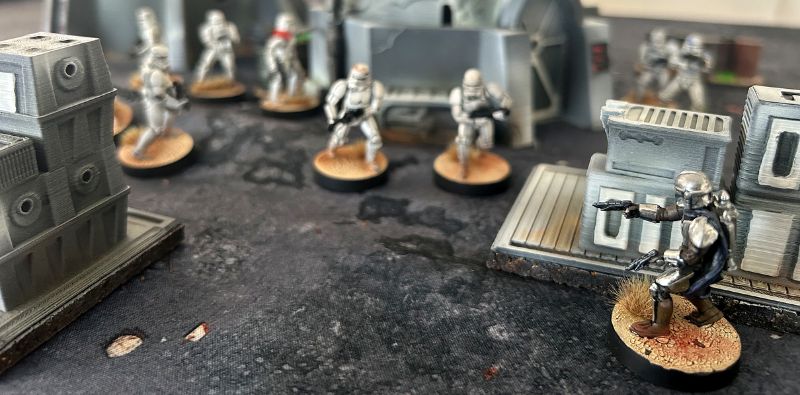
If you want a very thematic army, you can use the battle force rules. Battle forces represent specific subgroups that fought together within the lore, modifying the standard rank requirements and providing unique special rules for building your army.
Buying guide: what to get first
Deciding what to buy first is the most important step for any beginner. The easiest and usually most cost-effective way to enter the game is to buy a Star Wars Legion starter set. There are different entry points depending on the era of the galaxy you prefer.
The original two-player boxes are excellent starting points because they include everything two players need to learn the basics, including dice, measuring tools, tokens, and two small forces for learning games or skirmishes. For example, the Clone Wars era box includes forces for both the Republic and the Separatist Alliance, represented in the box by Trade Federation battle droids. If you choose this box, the Republic player receives Obi-Wan Kenobi, two units of clone troopers, and a BARC speeder. The Separatist player receives General Grievous, two units of nine battle droids, and two Droidekas. This box provides approximately 500 points per side, which is perfect for learning how to play.
Alternatively, Atomic Mass Games has introduced single-faction boxes adapted to the second edition. These boxes focus entirely on one army, such as the Galactic Republic. Interestingly, these single-faction boxes have an official retail price similar to the original two-player boxes. While the original two-player boxes include a mix of infantry and vehicles for two people, the new single-faction boxes are designed for one player and focus mainly on infantry units with better-balanced starter lists, generally omitting the vehicles included in the older boxes.
When expanding your collection, a Star Wars Legion core set or a faction-specific starter box will give you the fundamental troops you need. From there, you can buy individual expansions of characters, special forces, and heavy vehicles such as the AT-ST or the LAAT/le Patrol Transport.
Army building and Star Wars: Legion game formats
Once you have your miniatures, you need to organize them into a legal army. This is where using a digital Star Wars Legion army builder becomes incredibly useful, as it allows you to calculate the point cost of your units and their equipped upgrade cards to make sure you do not exceed the game’s point limits.
Your army is made up of units led by a unit leader, and you can customize them with upgrade cards that add new weapons, personnel, or equipment. You must also build a command hand made up of exactly seven command cards, which is used to determine priority and issue orders, as well as a battle deck made up of primary objective, secondary objective, advantage, and map cards.
The game supports several different formats, allowing players to play everything from quick skirmishes to huge multi-hour battles.
| Game format | Army point limit | Battlefield size | Description |
| Standard | 1,000 points | 6' x 3' (72" x 36") | The traditional full-scale battle format, with complete armies and the standard battle deck rules. |
| Recon | 600 or 800 points | 3' x 3' (36" x 36") | A faster, smaller-scale format, ideal for beginners or quick league rounds, representing forces that are the first to arrive in the combat zone. |
| Special operations | Predesigned units | Custom | A squad-level skirmish mode focused on narrative missions, customizable setups, and unique objective tokens. |
| Tours of duty | Progressive | Custom | A narrative campaign mode in which players create a “Paragon” leader, earn commendations, suffer setbacks, and play through a connected story arc. |
Basic mechanics and gameplay cycle
The game takes place over a series of rounds, usually five in the current standard format, which are divided into specific phases.
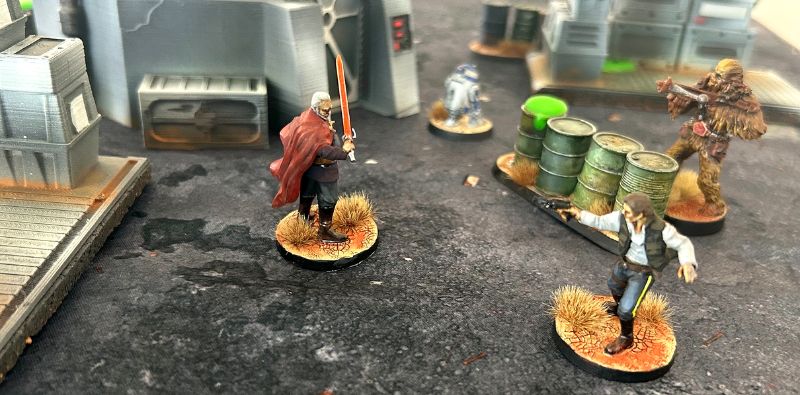
1. The command phase: at the beginning of the round, both players secretly choose a command card from their command hand and reveal it simultaneously. These cards have a number of “pips”, usually from one to four depending on the card, and the player whose card has fewer pips wins priority for the round, allowing them to activate a unit first. Command cards also allow players to issue orders to specific units on the battlefield, placing a face-up order token next to them. Units that do not receive a face-up order token place their token in an order pool.
2. The activation phase: players take turns activating their units. During an activation, a unit may perform up to two actions, such as moving, attacking, aiming, dodging, or recovering. Movement is handled using custom articulated movement tools that allow miniatures to move across the terrain with flexibility. When attacking, players use custom dice of several colors, red, black, and white for attacks; red and white for defense, to determine hits, critical hits, and blocks.
3. Suppression, cover, and morale: the battlefield environment plays a huge role in your tactical decisions. Units taking cover behind barricades or buildings can cancel incoming hit results. However, receiving heavy fire causes units to accumulate suppression tokens. If a unit’s suppression tokens equal or exceed its courage value, it becomes suppressed and loses one of its actions during its activation. If suppression reaches twice its courage value, the unit panics and suffers severe penalties. Units can attempt to rally and remove these tokens at the beginning of their activation by rolling defense dice.
The hobby and tournament scene
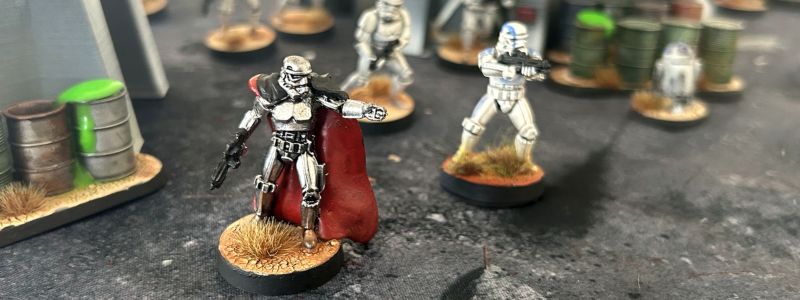
Star Wars: Legion is not just a board game; it is a complete hobby experience. Players must assemble and paint their miniatures before bringing them to the table.
If you plan to play in official Galactic Conquest events or local leagues, there are strict modeling guidelines. Miniatures must be easily identifiable and assembled using a majority of official Asmodee North America parts from the game’s range. Specifically, the rules state:
• The miniature must be made mostly from Asmodee North America parts belonging to the Star Wars: Legion line.
• The miniature must be easily identifiable as the version of the unit it represents.
• Players may not customize a miniature in a way that represents third-party intellectual property other than Lucasfilm, including copyrighted logos, symbols, or iconography.
• The size or pose of the customized miniature may not interfere with gameplay.
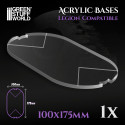
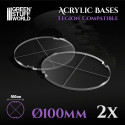
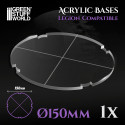
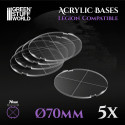
• Miniatures must always be attached to an official Atomic Mass Games base or to a modeled base that has the exact size and shape of the original base.
• Players must use official dice and measuring tools, although non-essential tracking tokens, such as aim or dodge tokens, may be replaced with custom acrylics as long as they do not alter or confuse the game state.
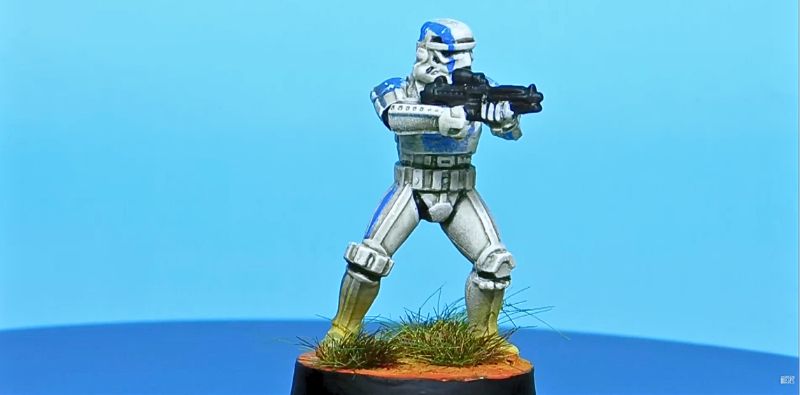
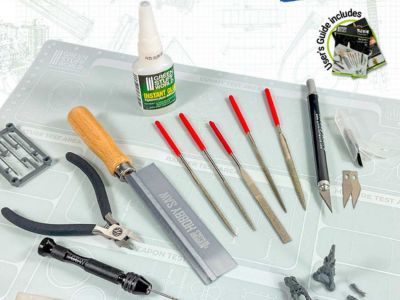
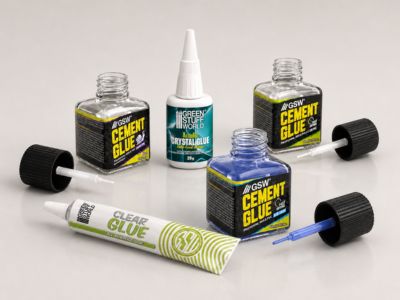
By contrast, the tools and supplies used to assemble, paint, and detail the miniatures can be freely chosen. You will need precision nippers, a hobby knife, primer, acrylic paints, and the different scenery elements you consider useful for decorating the bases as realistically as possible and fully immersing yourself in this universe. If you want a specific setting, you can use metallic paints or neon-effect paints, LED lights for the sabers, snow effects, the blackest black paint in the world to create a visual effect, among other effects and modeling products.
The game places great importance on sportsmanship and open information. Players are expected to maintain a correct game state, reveal their non-command cards to their opponents, and avoid intentionally rushing the opponent to force them to miss a gameplay opportunity.
If you understand the rules, choose the right starter products, and build a list that fits your tactical style, you will be well prepared to dominate the battlefields of the Star Wars: Legion galaxy.
Legal Notice
All trademarks, logos, and product names mentioned, including but not limited to Star Wars: Legion, and any other titles, are the property of their respective owners. The use of these names in this text is for informational and descriptive purposes only, with no intention of infringing intellectual property rights, copyrights, or registered trademarks.
This content is not sponsored, authorized, endorsed by, or affiliated with any of the owners of the trademarks mentioned, nor does it imply any commercial relationship with them. Any reference is made solely to facilitate the reader’s understanding within the context of informational content for miniature wargaming enthusiasts.
Furthermore, Green Stuff World is not associated with, licensed by, affiliated with, or authorized by the creators or owners of Star Wars: Legion or any other trademark mentioned. The mention of Green Stuff World is provided solely as an example of a general supplier of accessories and materials for modeling and wargames.
This text is provided for informational purposes only and is not intended to replace, replicate, or compete with the official products or services of any registered trademark.
Share this content