


What is the cel-shading technique in miniature painting?

Krillin painted with the toon-shading technique
The cel-shading technique in miniature painting is a stylistic method whose main objective is to make a three-dimensional physical object look flat, imitating the visual style of a comic book, a traditional illustration, or an animated series. Also known as toon shading, this technique moves away from photorealism and smooth color transitions to focus on high contrast and the application of clearly defined blocks of color.
Unlike traditional miniature painting techniques, which aim to simulate realistic volume through gradients, cel-shading requires the painter to reduce the color palette to just a few tones per area and clearly separate highlights from shadows. The result is a piece that looks hand-drawn, achieving a visual impact based on saturation and the rigid demarcation of its shapes.
Differences between cel-shading in 3D design and miniatures
The term cel-shading is not used only in miniature painting, and it is interesting to know how to distinguish it so you do not confuse one technique with another. In computer graphic design, cel-shading is a non-photorealistic rendering process. In this field, a computer program calculates the lighting of a virtual 3D model and applies a filter or algorithm that reduces light gradients into bands of solid color, automatically adding black outlines so that three-dimensional graphics look like flat illustrations.
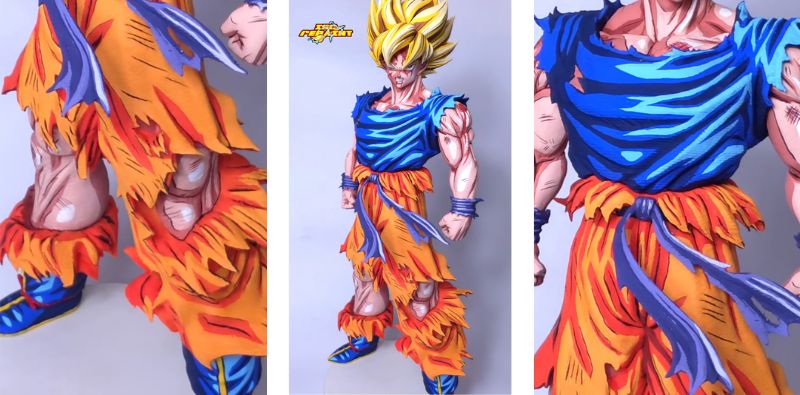
Goku Super Saiyan painted by @isc_repaint
By contrast, the cel-shading technique in miniature painting works through an adaptation to the real world. The artist begins with an object that is already three-dimensional and physical, one that naturally interacts with the surrounding light by creating its own midtones and smooth gradients. To achieve the comic book effect, the painter must destroy that natural lighting by omitting blended midtones. Instead, the painter ignores blending and paints hard lines and opaque color blocks directly onto the topography of the figure, forcing the eye to perceive the 3D figure as a 2D representation.
Fundamental principles of the cel-shading technique
One of the pillars of cel-shading is the limitation of the color palette and its application through solid blocks. Instead of mixing colors directly on the miniature, wet blending, between three and five layers of different color are applied to each surface, reducing the painted area with each additional layer to build the brightest highlight areas. Paint washes are rarely used in this technique, since they do not generate the rigid and controlled shadows required by the comic book style.
Understanding directional light is another strict principle. Although the final result should look like a flat drawing, the artist needs to understand how light would hit the volume of the object in order to place the color blocks in the anatomically correct position. A common and very practical method to solve this problem is to prime the miniature in black, position it under a single light source, and take several photographs from different angles. These photographs will serve as a fixed reference throughout the entire painting process to know exactly where to place the highlight blocks and the shadow blocks.
Color choice in cel-shading rejects the precise representation of reality in favor of visual impact. The chosen colors are usually very saturated and vibrant tones. The objective is not to ask what color an object really is in the physical world, but what color will create better visual readability and greater contrast in the composition.
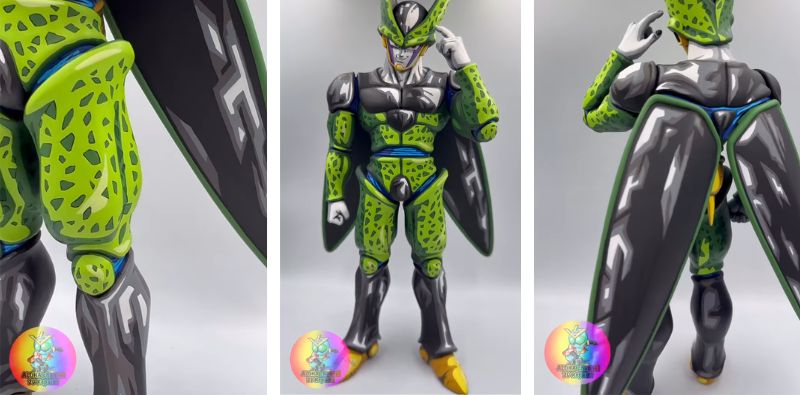
Perfect Cell from Dragon Ball Z painted by @alohachannel_
The treatment of metals also follows specific rules. Traditional metallic paints, with shiny pigments or glitter, are usually avoided. Instead, a simplified version of the “Non-Metallic Metal” technique, or NMM, is used. Conventional opaque acrylic paints are used, selecting around four solid tones, for example bluish gray for areas above the vertical, gray for the vertical, dark blue for the shadow, and black for the deep shadow. This approach fragments the metallic reflection into hard sections of light and shadow.
Recommended materials and tools
To execute the cel-shading technique in miniature painting effectively, it is necessary to have materials that favor color opacity and make it easier to outline the shapes. Depending on the final colors, artists adjust their primers and tools to achieve clearly defined color cuts.
| Material | Use in the cel-shading technique | Recommended example or variant |
| Primer | Establishes the base. Black is used to make photographic light references easier, or white for very vibrant colors. | Matte black or white primer depending on the desired level of saturation. |
| Opaque acrylic paints | Building solid colors without transitions. | They require high coverage. Opaque, saturated colors, avoiding metallic paints with real shine. |
| Acrylic inks | Deep shadows and outlined areas in recesses. | Fluid black acrylic ink, for example India Ink. |
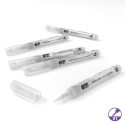
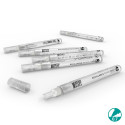
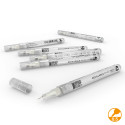
| Refillable markers | Outlining or blacklining hard edges in a controlled and uniform way. | Black acrylic paint marker with fine and chisel tips. |
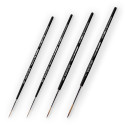
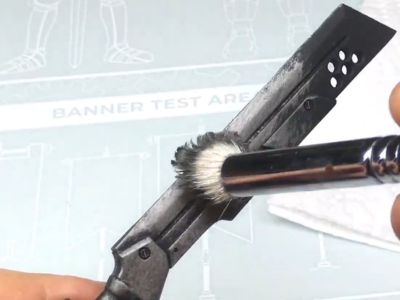
| Cel-shading brushes | Application of base blocks, with a soft brush, and tiny details or edge highlighting, with a fine brush. | Fine-tip detail brush, cylindrical brushes for blocking strokes. |
The step-by-step process to apply the cel-shading technique in miniature painting
The work order must be methodical and structured. Unlike other painting techniques where it is possible to improvise through glazes, here the stages are rigidly separated to maintain the visual cleanliness of the color divisions.
1. Preparation and light study. Prime the figure and take photographs with zenithal or directional lighting to use them as a permanent map of highlights and shadows, optional.
2. Base coat. Apply a solid, high-coverage layer of paint to all areas, making sure no irregular texture remains.
3. Blocking shadows and midtones. Apply the intermediate and shadow colors, always adjacent to one another and without trying to blend the lines that separate them. The cuts between colors must be precise.
4. High highlights and reflections. Add the lightest color to the areas that receive direct light, in some specific points even applying dots or small lines of pure white to simulate characteristic animation reflections.
5.Blacklining. Draw pure black lines around the contours, edges, and recesses of the miniature to visually separate each color segment. In certain areas, darker tones can be used instead of black for this outlining, so the miniature does not become oversaturated with black.

Classic Bardock from Dragon Ball Z painted by @alohachannel_
The importance of outlining and cross-hatching
Blacklining or outlining is the step that consolidates the cel-shading technique in miniature painting. It consists of going over the contours of the miniature, the structural folds, and the separations between materials using pure black. This process can be carried out using dense acrylic inks applied with a detail brush, or by using acrylic paint markers that provide lines of consistent thickness. It is essential to outline only the main edges and details that need depth, since too many lines can oversaturate the figure and make it visually confusing.
In addition to the outer outlining, this technique relies on cross-hatching and textured shadow marks. Adding fine diagonal lines, simulated scratches, or marks made of three to four parallel strokes on flat panels or at the junctions between colors directly evokes the inking style of classic comic book illustrators. These details do not strictly respond to how light works in physics, but rather are conventions of 2D drawing that, when transferred to the miniature, improve the geometric readability of the model.
Base design and visual presentation
For the optical illusion to remain cohesive, the physical environment of the miniature must share the same visual rules. A fundamental aspect of the cel-shading technique in miniature painting is base design. If a model painted with rigid shadows sits on a base textured with sand, static grass, and a realistic finish, the visual dissonance immediately breaks the comic book effect.
The bases should be painted flat or, failing that, the same rules of solid blocks and outlining applied to them as to the miniature. The ground of the base serves as an artificial two-dimensional background that contextualizes the three-dimensional figure.
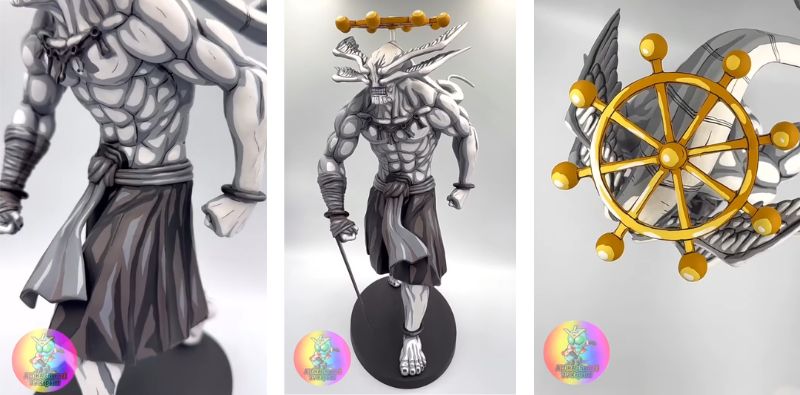
Mahoraga from Jujutsu Kaisen painted by @alohachannel_
The use of color on these bases also helps maintain the illustrated atmosphere. Instead of being limited to grays or earthy browns, using vibrant or even inverted colors, such as cobblestones in purple tones with light lilac outlines, helps chromatically separate the ground from the feet of the miniature, reinforcing that ecosystem of absurd and unreal contrasts typical of graphic novels.
Scale and tabletop distance in the cel-shading technique
Implementing the cel-shading technique in miniature painting requires anticipating the distance from which the piece will be viewed. During the painting process under a magnifying lamp, very fine black lines and tiny details may seem appropriate. However, when the miniature is placed on a gaming table at a standard distance, these fine details tend to disappear, which makes the colors look blurry or blended, ruining the intended effect.
To solve this distance perception problem, known in the hobby as tabletop distance, the black separation lines must be drawn with a much more pronounced thickness than might seem logical up close. A thick and decisive demarcation ensures that the color blocks remain clearly separated for any viewer, preserving the animation aesthetic regardless of how far the miniature is from the person observing it.
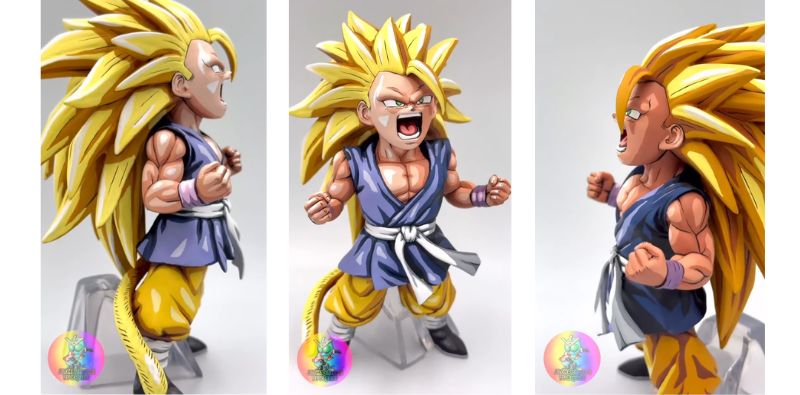
Kid Goku Super Saiyan 3 painted by @alohachannel_
Ultimately, this painting discipline places visual contrast above everything else, choosing to build schematic color maps instead of recreating physical textures. The technique requires the artist to reinterpret volumes, forgiving minor mistakes through the inclusion of “dirty” shadows or imperfect cross-hatching that, paradoxically, increase the resemblance of the object to a traditional ink drawing.
Mastering the cel-shading technique in miniature painting offers, through the imposition of blocked colors, strict lighting, and edge outlining, the possibility of achieving miniatures and figures in general that can be transformed into a tangible illustration taken directly from a comic panel.
Share this content