

Best glues for plastic model kits
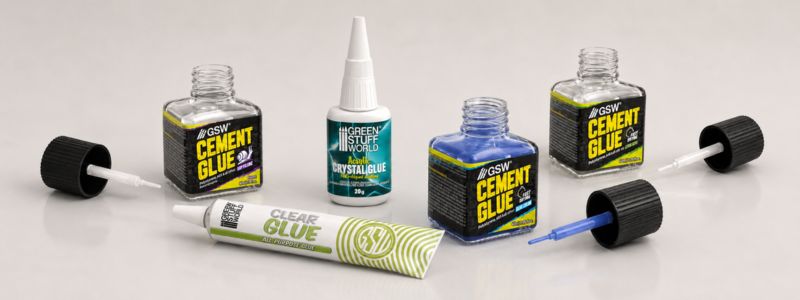
Entering the world of modeling and miniature building is a path full of satisfaction, but it also requires making the right decisions about the tools and materials you are going to use. One of the most decisive elements for your project to have a clean and durable finish is, without a doubt, the choice of adhesive. Using the wrong product can ruin hours of assembly and sanding, while choosing correctly ensures that your figures and scenery remain firmly in place over time. For this reason, in this guide we will take an in-depth look at the best glues for plastic model kits and other essential adhesives that you will need on your workbench.
Often, when starting out in this hobby, it is common to think that any universal glue or household adhesive will work. However, in modeling there is a wide range of glues, each one with very specific functions depending on the material, the type of bond, and the finish you want to achieve. The materials that make up today’s assembly kits have very particular physical and chemical properties. Throughout this text, you will learn to distinguish between the different types of bonds, how each material reacts, and which solutions are ideal for each specific situation, always based on Green Stuff World’s specialized catalog.
What is glue for model kits?
In general terms, when we talk about glue for model kits and modeling, we are referring to a category of adhesives specifically formulated to bond small parts, delicate components, and different materials that often come together in the same project. Unlike standard household adhesives, these products are designed to offer precise control during application, avoid excess residue that could spoil the details of the parts, and ensure a bond capable of withstanding the later painting and handling process.
This type of adhesive covers a wide variety of chemical compounds, each one adapted to a different need. Generally, a good modeling adhesive must meet the following essential requirements:
• Application control: precise dispensers, brushes, or fine cannulas to prevent stains.
• Material compatibility: formulas that do not damage or deform delicate components.
• Resistance to later processing: ability to withstand sanding, priming, and painting.
There is no single glue that works for everything in modeling, since you will often have to combine plastic, metal, wood, resin, or plant elements to build your dioramas or bases. For this reason, understanding the function of each adhesive will save you many setbacks.
What is glue for plastic model kits?
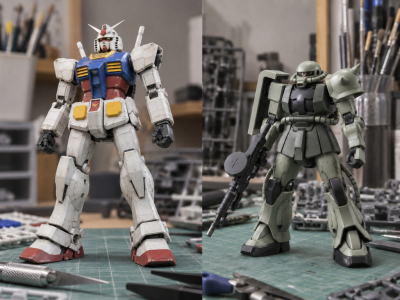
When we focus on plastic, the traditional concept of “gluing” changes completely. The vast majority of aircraft, vehicle, soldier, or wargame figure kits that you will assemble are made of polystyrene, styrene/HIPS, or ABS, although they may include other materials. To join these components, the most effective method is not to add an external adhesive film that holds the parts by friction, but to chemically melt them.
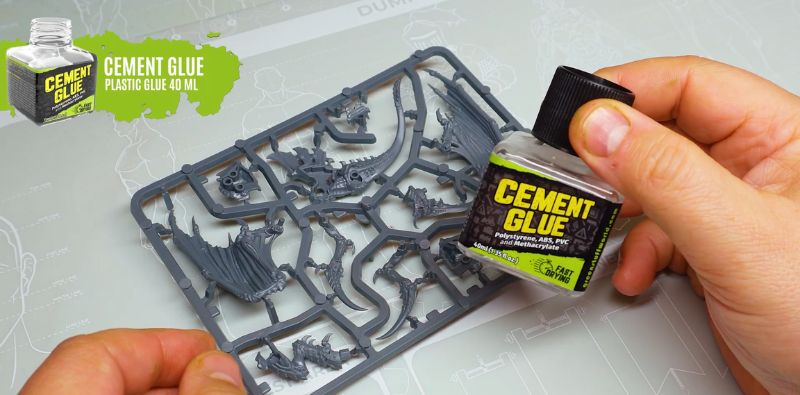
Specific glue for plastic model kits acts as a strong solvent. The process by which this bond is produced follows very clear steps:
1. Application: When you place the glue on the two surfaces you want to join, it softens and slightly dissolves the surface layer of the plastic.
2. Fusion: When the pieces are joined immediately, the softened plastic layers mix with each other at a molecular level.
3. Evaporation: As the solvent evaporates, the plastic hardens again, forming a single solid and integrated piece.
This process is technically known as chemical welding or solvent welding. In this way, you achieve an extremely strong bond with no visible seams, which you can later sand and polish normally to remove any imperfections from the joint.
To make the most of this effect and achieve a clean finish, it is recommended that you carry out dry-fit tests before applying the product. When working with these solvents, it is very important to do so in a well-ventilated space, since the evaporation of the chemical components releases strong fumes that should not be inhaled. If you are looking for the ideal options for your workbench, knowing the best glues for plastic model kits will allow you to select the viscosity and drying time that best suit the size of the parts in your model.
Types of glue for plastic model kits and their characteristics
Chemical welding cement: Skullglue
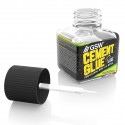
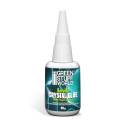
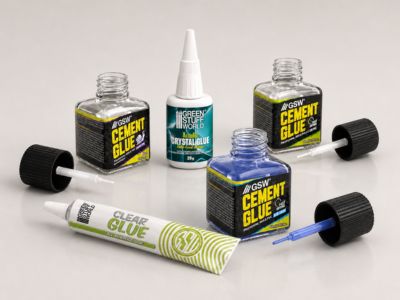
Within the specialized catalog, one of the most widely used products designed under the concept of chemical welding is the well-known Skullglue. This solvent-based adhesive stands out as one of the best glues for plastic model kits because of its ability to effectively fuse materials such as polystyrene, ABS, methacrylate, and PVC. When Skullglue is applied, the surfaces bond at a molecular level, creating a unified and resistant structure.
Green Stuff World offers different versions of this glue to adapt to your working pace:
• Plastic glue classic fast-application version. Ideal for quick and precise standard bonds.
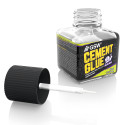
• Slow plastic glue 40 ml. This variant is ideal when you need to make meticulous adjustments on complex parts or when the assembly requires aligning several components before the adhesive begins to harden.
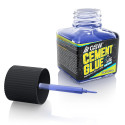
• Blue plastic glue 40 ml. It includes a tint that helps you clearly see where you have placed the product, which is very useful for avoiding excess that could damage the engraved details on the model.
Fast adhesives: cyanoacrylate glue
Although solvent welding is ideal for polystyrene, you will often encounter polyurethane resin parts, photo-etched metal parts, or multi-material miniatures. In these scenarios, plastic solvent will not work. This is where cyanoacrylate glue, popularly known as super glue, comes into play. This fast adhesive is an essential inclusion in any selection of the best glues for hard plastic model kits and modeling in general because of its versatility, as it bonds metal, resin, hard plastic, and wood in just a few seconds.
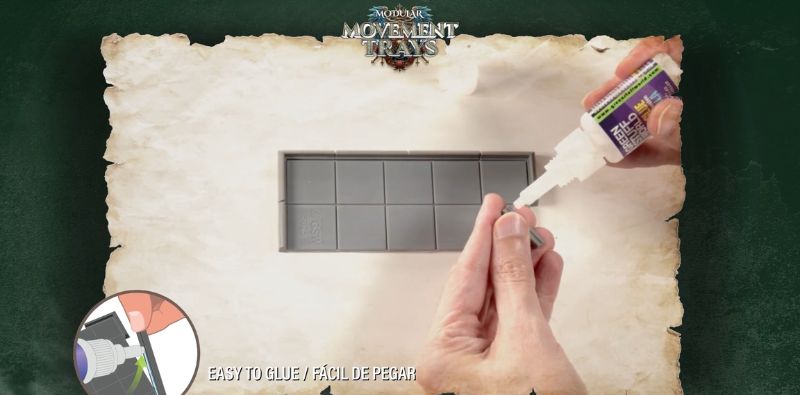
To cover all your needs, you have two cyanoacrylate formats with different densities:
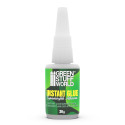
• Traditional liquid version. Low viscosity, perfect for flowing by capillary action into narrow joints or small cracks.
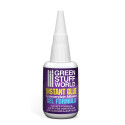
• 20 g cyanoacrylate gel glue. Its thick consistency prevents it from dripping or running, giving you excellent control while positioning the part on vertical surfaces.
In addition, to optimize the use of cyanoacrylate, you have very practical accessories in the Green Stuff World catalog:
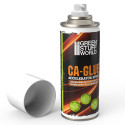
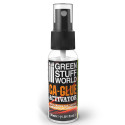
• Cyanoacrylate activator spray. It accelerates the chemical reaction and cures the adhesive instantly, ideal for difficult parts or parts under tension.
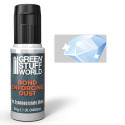
• Cyanoacrylate glue hardener. A fine reinforcing powder that mixes with the adhesive to create a solid bond, fills irregular gaps, and is perfectly sandable.
• Cyanoacrylate cleaner. It safely dissolves glue residue without damaging your miniatures or tools if you make an application mistake.
Structural adhesion: two-component epoxy glue
For bonds that need to support considerable weight or significant structural stress, such as fixing large figures to their bases or securing heavy scenery elements, fast adhesives or solvent adhesives may be insufficient or too fragile. In these cases, two-component epoxy glue establishes itself as a high-strength resource that deserves to be included in the list of the best glues for plastic model kits and other demanding supports.
This product, available in a 30 ml format, consists of a resin and a hardener that you must mix in equal parts before application. Its main characteristics include:
• Stable chemical reaction. When mixed for approximately one minute, curing begins without depending on solvent evaporation.
• Long open working time. It offers around 5 minutes to place and adjust complex components with complete calm and precision.
• Great filling capacity. It fills gaps excellently and is highly resistant to water and humidity, ensuring that your dioramas and multi-material assemblies remain intact against the passage of time or wet painting, washing, or texturing processes.
Comparative table of modeling adhesives
To help you quickly decide which product to use at each stage of your project, below you have a comparative table with the main options from the Green Stuff World catalog:
| Type of Adhesive | Featured Product | Recommended Materials | Type of Bond | Key Characteristics |
| Chemical Welding | Skullglue (Classic / Slow / Blue) | Polystyrene, ABS, PVC, methacrylate | Molecular fusion | Ultra-strong, invisible, and fully sandable joint. |
| Cyanoacrylate | Cyanoacrylate Glue (Liquid / Gel) | Metal, resin, rigid plastic, wood | Instant adhesion | Dries in seconds; highly versatile for multi-material parts. |
| Two-Component Epoxy | Epoxy Glue 30 ml | Metal, hard plastic, wood, resin | High-strength structural bond | Excellent for heavy parts; allows gaps to be filled. |
| White Glue | Craft White Glue | Wood, paper, cardboard, cork | Medium-drying porous bond | Non-toxic; cleans with water and dries transparent. |
| Flocking Glue | Flocking Glue (Tuft Glue 60 ml) | Static grass, flocks, vegetation | Flexible transparent bond | Special for bases; allows repositionable tufts to be created. |
| Permanent Spray | Permanent Spray Glue 400 ml | Scenery, cardboard, large areas | Fast and even coverage | Transparent finish; ideal for covering large terrain areas. |
| Contact Adhesive | Contact Adhesive | Rubber, leather, wood, metal, plastic | Contact adhesion | Fast drying; high immediate adhesion after evaporation. |
| Acrylic Glue | Crystal Glue 20 g | Transparent acrylic plastic parts | Clean transparent bond | Does not whiten or fog aircraft canopies or visors. |
Other glues for model kits
Although compounds that melt or bond rigid plastics are essential for your figures, any modeler worth their salt knows that a complete project involves scenery, terrain, and bases. If we limit ourselves only to the best glues for plastic model kits, we would lose sight of fantastic tools for other materials that will bring your environments to life.
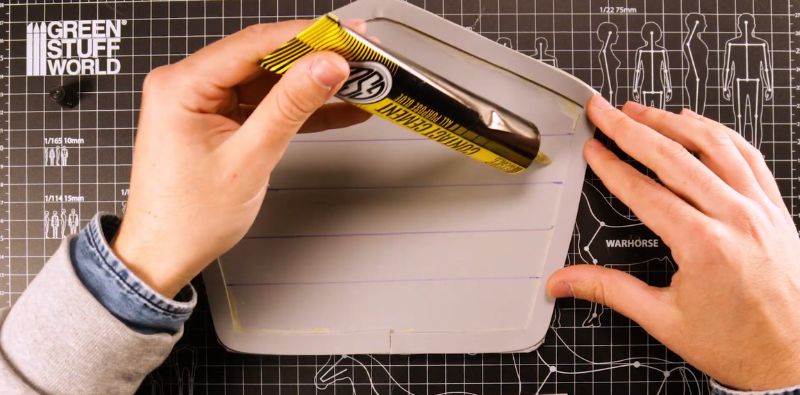
Below, we review other adhesive solutions from the Green Stuff World catalog that you should keep in mind:
• Craft PVA glue. Based on polyvinyl acetate, PVA, it is your essential tool if you work with wood, paper, or cardboard for your buildings and integrations. It is safe, non-toxic, cleans with water before drying, and offers a very clean transparent finish.
• Tuft glue, 60 ml Tuft Glue. This high-adhesion water-soluble adhesive is specifically designed to permanently fix static grass tufts, helping the fibers remain in a vertical position. It dries completely transparent and is ideal if you make your own self-adhesive tufts on baking paper.
• Adhesive spray 400 ml. Very practical when you need to cover extensive terrain surfaces or prefer a fast method for fixing large areas of flocking, static grass, or scale trees to your model kits.
• Repositionable stencil glue. If you work with stencils to paint details with an airbrush, this product allows you to fix Mylar sheets temporarily and safely, adapting them to curved surfaces without leaving sticky residue when removed.
• Contact glue. Available in 100 ml or 500 ml formats with an applicator brush, it is very useful for specific parts of your project that require a fast contact grip on large surfaces.
• Silicone glue, 45 ml Clear Glue. It works very effectively in crafts for gluing flexible materials such as EVA foam or soft plastics such as PLA.
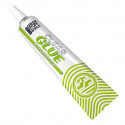
• Crystal Glue 20 g. If your model contains completely transparent acrylic plastic parts, such as aircraft canopies, visors, or windows, this is your ideal option, as it dries with total clarity, preventing the unsightly fogged effect caused by cyanoacrylate.
• 11 mm hot glue gun sticks. Available in transparent or black versions, they make it easier, together with the hot glue gun, to create internal support structures, quick volume for terrain, or immediate fixings in large-scale scenery.
• Silicone spatulas. To apply and spread glues evenly without ruining your fine brushes, these accessories will be convenient and extremely easy to clean.
Tips for clean and safe application
To ensure that your experience with modeling glues is always satisfactory, we suggest following these simple safety and practical application guidelines:
• Ventilation. Always work in a well-ventilated area to dissipate solvent and cyanoacrylate fumes.
• Moderation. Always apply the product in moderation; in modeling, less is more. Using too much will only cover details or soften the plastic in unwanted areas.
• Maintenance. Keep the bottles tightly closed when you are not using them to prevent them from drying out, and clean the nozzles or application cannulas before storing them.
• Preparation. Always carry out dry-fit tests before applying any final adhesive to make sure the joint closes perfectly.
With a little practice and patience, you will make your bonds invisible and give your model kits a clean, professional finish using the best glues for plastic model kits.
Share this content