



BattleTech in 2026: new boxes, new rulebook, and a beginner’s guide
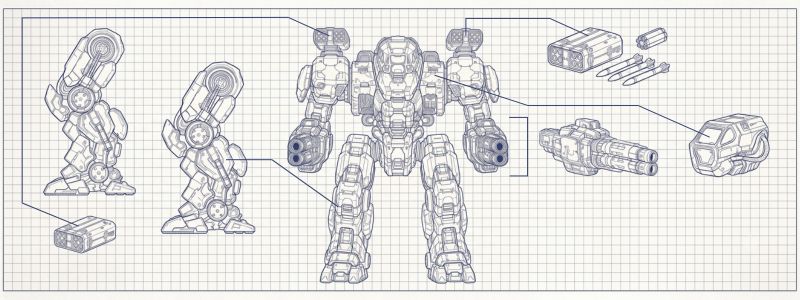
What BattleTech is and where it comes from
For those who come across the BattleMech franchise, often shortened to ’Mech, for the first time and ask what is Battletech, it is a complex tactical tabletop wargame centered on armored combat in the 31st and 32nd centuries. Players take on the role of MechWarriors, highly trained pilots who operate enormous humanoid combat machines known as BattleMechs across maps with a hexagonal grid. BattleTech is more than 40 years old; its origins go back to 1984, when it first appeared under a different name before evolving into the science fiction benchmark we know today.
Over the decades, the game has maintained a very loyal global community, supported by the current official publisher, Catalyst Game Labs. The core mechanics of the game have remained remarkably consistent since the second edition boxed set in 1985, with a focus on armor degradation, internal structure damage, and careful resource management.
The 2026 Refit & Redeployment releases
On March 24, 2026, Catalyst Game Labs announced a major joint product release titled “Refit & Redeployment,” scheduled for August 2026 and available during the Gen Con Game Fair 2026. This release is not a new edition of the game, which means that existing maps, rulebooks, and miniatures remain fully compatible. It is a structural reorganization of the core products so that the first steps into the game are easier, while also offering a more cohesive and accessible core rulebook for both veterans and new players.
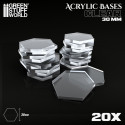
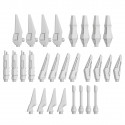
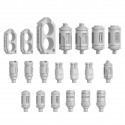
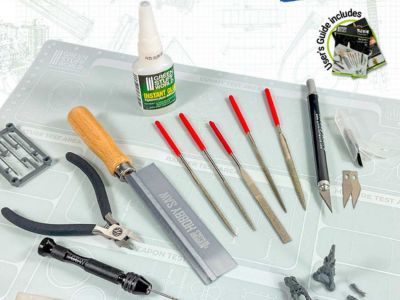
It is important to note that the miniatures are sold assembled, but unpainted. Therefore, if you want to paint your ’Mechs, you will need acrylic paints. In addition, if you want to customize them, you can use paint effects and bits as 'Mecha details parts.
The release revolves around three main products:
• Starter Box: designed specifically to make it easier for new players to enter the tabletop experience. The back of the half-page record sheets now includes a preview of advanced equipment and rules. It contains two unpainted BattleTech miniatures specific to the ilClan era: the Hammerhead and the Kontio.
• Core Box: building on the foundation of previous boxes, this release introduces the Sagas background booklet. This booklet works as an introduction, offering new art and guiding players through faction selection and playstyles.
• Core Rulebook: after six months of public testing, this book compiles the most cohesive ruleset to date. It includes a complete Missions section that works as a toolbox so players can build anything from quick, improvised games to huge, epic clashes.
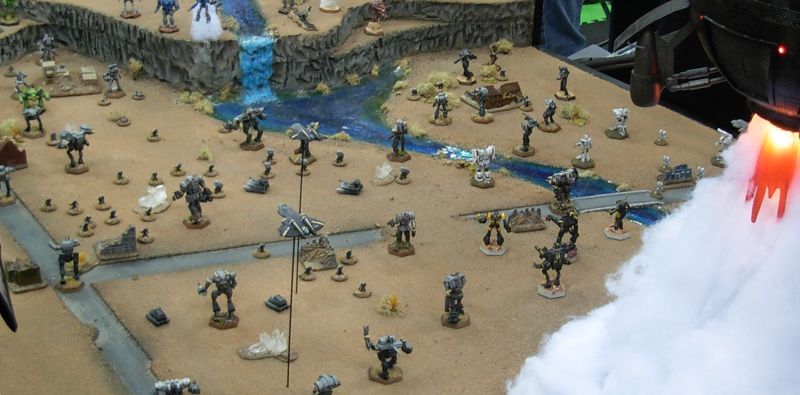
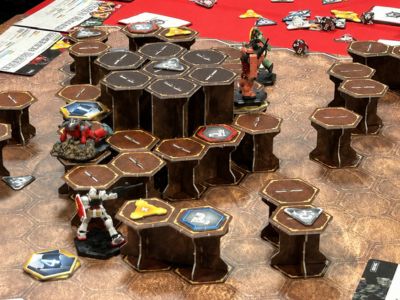
Image: BattleTech board at Gen Con Indy 2007, by Piotrus, via Wikimedia Commons: https://commons.wikimedia.org/wiki/File:Gen_Con_Indy_2007_-_miniature_wargame_terrain_board_-_(BattleTech)_01.jpg. Licensed under CC BY-SA 3.0: https://creativecommons.org/licenses/by-sa/3.0/
To provide a clearer view of the contents of the Core Box, here is a table with the eight classic BattleMechs included, representing more than thirty years of franchise lore:
| BattleMech name | Original debut source |
| Hollander | Technical Readout: 3055 |
| Rakshasa | Technical Readout: 3055 |
| Solitaire | Technical Readout: 3067 |
| Uziel | MechWarrior 4: Vengeance |
| Mad Cat Mk II | MechWarrior 4: Vengeance |
| Vulture Mk IV Prime | MechWarrior: Dark Age |
| Regent | ilClan Era Recognition Guides |
| Eris | ilClan Era Recognition Guides |
The factions of the Inner Sphere
In the classic era, BattleTech is politically divided into five great interstellar empires known as the Successor States, each ruled by a Great House: Davion, Kurita, Steiner, Marik, and Liao. Each one governs a Successor State and has its own political, military, and cultural identity. Depending on the era of play, their leaders, alliances, and territories can change, so it is best to understand them as major historical blocs rather than static factions.
• House Davion, Federated Suns: ruled by Hanse Davion, known as “The Fox,” it is usually recognized as the most powerful military force among the Successor States. It is partially allied with House Steiner and places great value on skillfully executed military campaigns and subtle diplomacy.
• House Kurita, Draconis Combine: ruled by Coordinator Takashi Kurita, this faction operates under strict martial traditions. It maintains a deeply rooted enmity toward House Davion due to historical massacres, such as the infamous Kentares IV incident.
• House Steiner, Lyran Commonwealth: led by Archon Katrina Steiner, this wealthy faction controls crucial industrial worlds such as Hesperus II. Despite past military defeats, its immense economic power allows it to deploy large numbers of heavy and assault BattleMechs.
• House Marik, Free Worlds League: Captain-General Janos Marik governs a fractured territory, frequently affected by civil wars and internal rebellions from powerful local dukes.
• House Liao, Capellan Confederation: often represented in the classic eras as the weakest of the five states, led by Chancellor Maximilian Liao. After losing a significant amount of territory over the centuries, it relies on espionage, covert operations, and an alliance with Houses Kurita and Marik to survive Davion aggression.
Mercenaries and the Periphery
Beyond the structured armies of the Great Houses, the galaxy is populated by independent mercenary units and pirate factions. Famous mercenary groups include Wolf’s Dragoons, an elite unit commanded by Colonel Jaime Wolf, known for possessing formidable, non-standard technology. The Eridani Light Horse, a remnant of the ancient Star League Defense Force (SLDF), specializes in reconnaissance and light combat.
In the lawless space known as the Periphery, Bandit Kings rule scattered planets. Figures such as Hendrik III of Oberon IV and Redjack Ryan of Butte Hold command improvised forces of old BattleMechs and survive through raids against vulnerable border worlds.
Campaigns and expansions: the Snowblind experience
For players looking for structured narrative play, the franchise offers several campaign expansions. Showcased at AdeptiCon 2026, BattleTech Aces: Snowblind is an expansion designed for cooperative or solo play using the Alpha Strike ruleset. Set on the politically unstable planet of Thule during the ilClan era, players build a mercenary force to fight through a branching story involving the Rasalhague Dominion.
For players asking how long is Battletech campaign, it should be calculated by taking into account that the Snowblind expansion book is made up of 100 pages and includes 2 tutorial missions and 20 full campaign missions. The system automates enemy behavior through specific Aces and Commander card decks, which determine the movement and target-selection priorities of opposing units without requiring a human player to control the enemy. It also includes 8 ’Mechs.
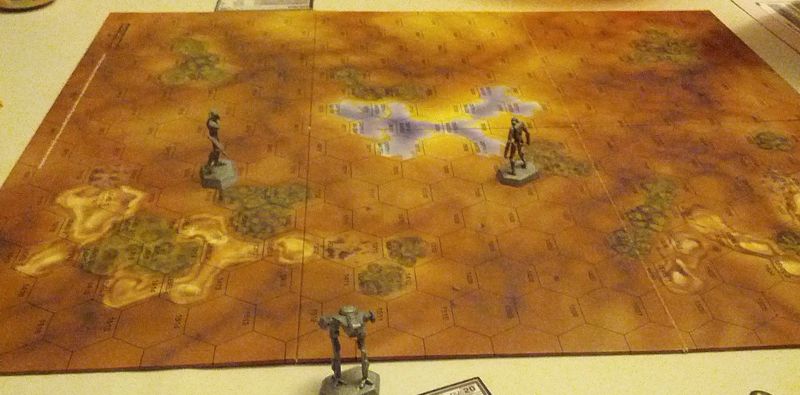
Image: “BattleTech game”, by Jorge Sanz, via Wikimedia Commons: https://commons.wikimedia.org/wiki/File:Battletech_Alpha_Strike_y_me_han_reventao_el_cacharro_U_U_(15510414083).jpg. Licensed under CC BY-SA 2.0: https://creativecommons.org/licenses/by-sa/2.0/
The physical product line adapts to different aesthetics and playstyles. There are also collectible products and special boxes, such as Battletech Gothic or the Salvage Boxes, although they are not the most recommended entry point for beginners. In addition, while the tabletop game provides strict physical rules, the digital community thrives by creating various Battletech mods for video game adaptations, in order to replicate tabletop scenarios or introduce new tactical layers. As for how many mechs are in Battletech, the BattleTech universe includes thousands of variants published in record sheets and supplements over more than forty years, although not all of them currently have a physical miniature available. Even so, it offers a great variety of combinations for force building.
How to play BattleTech: fundamentals
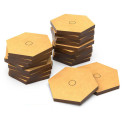
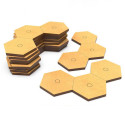
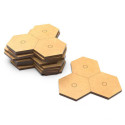
To understand how to play Battletech, you need to know three fundamental pillars of the wargame: movement, combat, and heat management. Regarding the game board, each hexagonal space on the map represents approximately 30 meters of terrain, and each game turn represents 10 seconds of real-time combat. The BattleMechs themselves are machines that stand approximately 12 meters tall and are represented at a 6 mm scale, from 1:256 to 1:285.
Movement dynamics
During the movement phase, a player can choose for their ’Mech to remain stationary, walk, run, or jump. Each ’Mech has a specific number of Movement Points, or MP. Entering different types of terrain costs different amounts of MP. For example, moving into a clear hex costs 1 MP, but entering a heavy woods hex costs 3 MP.
Running provides 1.5 times the walking MP, allowing for rapid repositioning, but it makes the ’Mech a harder target to hit while also reducing its own firing accuracy. Jumping ignores standard terrain penalties during the flight path, but generates a large amount of heat and severely penalizes the weapon accuracy of the jumping ’Mech.
Ranged combat
Combat is resolved using two six-sided dice, or 2D6. To attack successfully, a ’Mech must have a clear line of sight to the target, meaning there must be no blocking terrain, such as several heavy woods hexes or high hills, obstructing the view.
The base target number is determined by the MechWarrior’s Gunnery Skill, usually 4. This number is then modified by the attacker’s movement, the target’s movement, meaning how many hexes it crossed, the weapon’s range bracket, short, medium, or long, and intervening terrain. If the dice roll equals or exceeds the modified target number, the weapon hits. The damage is then applied to a specific location on the enemy ’Mech, determined by rolling on the hit location table.
Heat management
The most critical aspect of piloting a BattleMech is controlling its internal temperature. Actions such as running, jumping, and firing energy weapons generate heat points. A ’Mech uses internal heat sinks, or Heat Sinks, to dissipate this heat at the end of the turn; a standard ’Mech with 10 heat sinks can dissipate 10 heat points per turn. If a player generates more heat than the ’Mech can dissipate, the internal temperature rises on the tracking scale.
Operating at high temperatures causes severe and cumulative penalties. At 5 heat points, the ’Mech loses 1 MP. At 14 heat points, the fusion reactor has a chance to shut down automatically. At 19 heat points, internal ammunition can explode, causing catastrophic structural damage and inflicting 2 wounds directly on the MechWarrior.
Advanced mechanics: physical combat and environments
Beyond shooting, BattleMechs can perform devastating physical attacks in close-range melee combat. There are four main types of physical attacks:
1. Punch: a ’Mech can punch with its arms if it has not fired weapons from those arms during the same turn. A punch deals 1 point of damage for every 10 tons of the attacker’s weight. Punches are very effective because the damage is resolved on a specialized table that only hits the upper half of the target: torso, arms, or the head, which is especially vulnerable.
2. Kick: a ’Mech can deliver a kick, which deals 1 point of damage for every 5 tons of weight, meaning it causes twice as much damage as a punch. Kicks automatically target the enemy’s legs and can potentially cripple its movement.
3. Push: instead of dealing direct damage, a ’Mech can use both arms to push an opponent into an adjacent hex. If successful, the target is displaced and must pass a Piloting Skill roll to avoid falling to the ground.
4. Death from Above, or DFA: the most spectacular physical attack consists of a ’Mech using its jump jets to land directly on top of an enemy. This attack deals a large amount of damage to the target’s upper body, calculated by dividing the attacker’s weight by 10 and multiplying it by 3. However, the attacker also takes damage to its own legs and risks falling if the maneuver fails.
The environment also plays an active role in the advanced rules. ’Mechs standing in water hexes gain significant cooling benefits; Depth 1 water cools the legs, dissipating 1 additional heat point for each submerged heat sink, while Depth 2 water fully submerges the ’Mech, maximizing cooling efficiency but preventing the use of submerged weapons. Conversely, weapons such as lasers and flamers can be used intentionally to set forest hexes on fire, creating hazardous zones that generate additional heat for any ’Mech passing through them.
This is everything basic you need to know before you start playing BattleTech, a wargame that remains one of the most resilient and intricate tactical games within the tabletop miniatures hobby. Whether you are customizing the armor, weaponry, and heat management of a 60-ton heavy ’Mech or managing the intense heat scale during a desperate firefight, the game rewards strategic planning and risk management. With the 2026 release of the new Core Rulebook and Starter Boxes, the barrier to entry has been significantly lowered, offering the perfect opportunity for new commanders to claim their place in the Inner Sphere.
Legal Notice
All trademarks, logos, and product names mentioned, including but not limited to BattleTech, and any other titles, are the property of their respective owners. The use of these names in this text is for informational and descriptive purposes only, with no intention of infringing intellectual property rights, copyrights, or registered trademarks.
This content is not sponsored, authorized, endorsed by, or affiliated with any of the owners of the trademarks mentioned, nor does it imply any commercial relationship with them. Any reference is made solely to facilitate the reader’s understanding within the context of informational content for miniature wargaming enthusiasts.
Furthermore, Green Stuff World is not associated with, licensed by, affiliated with, or authorized by the creators or owners of BattleTech or any other trademark mentioned. The mention of Green Stuff World is provided solely as an example of a general supplier of accessories and materials for modeling and wargames.
This text is provided for informational purposes only and is not intended to replace, replicate, or compete with the official products or services of any registered trademark.
Share this content