

How to thin acrylic paint

Acrylic paint is the soul of most projects for modeling artists. To obtain the desired result, the density must be correct, as not all contexts require the same fluidity. This is why, before painting, you must be clear about the technique to be used, since each one requires a specific thickness. Mastering how to thin acrylic paint is essential to achieve the expected result and go from a rough surface with brush marks to a work with perfect transitions, satin finishes, and smooth layers that respect every rivet and texture of the model.
Why is it necessary to thin acrylic paint in modeling?
Acrylic paints designed for the hobby are composed of three main elements: pigments (the color), acrylic resin (the binder that sticks the pigment to the figure), and water (the vehicle that keeps the mixture liquid). The viscosity of the paint ensures that the pigment does not degrade, which is why most manufacturing brands sell their acrylic paint thicker than strictly necessary so that it does not lose quality and lasts until the artist uses it.
Thinning it is not simply “making it more liquid”; it is a matter of physical and chemical control that allows for:
• Preservation of detail. A layer of color that is too thick when painting miniatures or busts fills in expression lines, skin textures, or the relief of armor. Proper dilution makes it easier for the paint to settle in a micrometric layer, maintaining the fidelity of the original sculpt.
• Elimination of surface tension. Pigment in pure paint tends to clump and “pull” on itself due to its high tension, which complicates uniform spreading. By thinning the paint with specific products, it slides smoothly over the surface, eliminating the unsightly bristle marks that appear when it starts to dry while still being spread.
• Management of opacity. Modern modeling is based on the accumulation of layers. Thinning makes it possible to work with transparencies, which facilitates advanced techniques such as glazes to create color filters, or layering, where tones are superimposed so subtly that the human eye cannot perceive where one color ends and the next begins.
• Improving adhesion and drying. A well-balanced mixture levels the drying time. If the paint is too thick, the outer layer dries before the inner one, which can cause cracks or unexpected textures. Controlled dilution ensures a uniform evaporation of the solvent.
How to thin acrylic paint with Green Stuff World products?
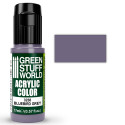
Green Stuff World acrylic paints are sold ready to use. They have been developed with their own MxxFormula, through which the perfect viscosity has been achieved to be able to paint with them without thinning but without losing coverage, adhesion, and vibrant color.
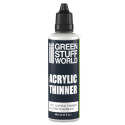
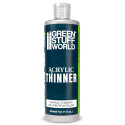
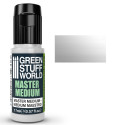
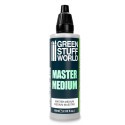
Even so, to carry out certain techniques, it is necessary to thin them. With both Master Medium and Acrylic Thinner, it is possible to change the structure of the paints to suit the technique you need. To do this, it is important to choose the right product and the amount of mixture with the paint.
The Master Medium adds transparency to the mixture without thinning it in the way that a thinner does. Primarily, you can achieve three different results:
• 100% acrylic paint: perfect for applying base coats and painting blocks of the same color such as a wall, a roof, or a coat over which to add details.
• 50% / 50%: the paint softens and spreads more uniformly, ideal for layering, a technique of painting by layers to make smooth color transitions, creating a gradient effect. This manages to create smooth transitions between shadows and highlights, provides volume and depth to the miniatures, or highlights specific details without the need for glazes.
• 20% paint / 80% Master Medium: creates a soft texture; it is used for glazing, a technique whose objective is to tint or filter a color already painted without covering it completely. Thus, transitions are softened, tones are changed to apply a filter of a specific color, or specific areas are shaded.

The thinner, on the other hand, makes it more fluid, primarily for use with an airbrush, although it can be used for other purposes depending on the consistency.
• 100% acrylic paint: apply color without any specific effect.
• 50% / 50%: this dilution is suitable for glazes.
• 20% acrylic paint / 80% thinner: such a thinned product is usually used to make washes, so that it flows into the nooks and crannies. Thus, when drying, it leaves the lower parts darker and enhances the details without completely covering the high areas.

To avoid losing the quality of the product and to obtain the best results, it is always advised to thin using a specific thinner for each type of product, so the best answer to the question “how to thin acrylic paint?” is with an acrylic thinner. However, other emergency methods may work.
Can you thin acrylic paint with water?
Technically, yes, since water is the natural solvent for water-based acrylic resins, but too much water can compromise the quality of the product. Water acts simply as a vehicle to reduce viscosity; however, it does not contain binders (“glue”). If the dilution exceeds a critical ratio, the polymer chains of the acrylic resin disperse so much that they lose their ability to form a solid and continuous film. This translates into a loss of adhesion and the so-called “chalky effect” can appear when the paint loses saturation, leaving a matte, pastel finish with irregular opacity. Likewise, pigments will accumulate at the edges of the mixture, since water droplets dry from the edges toward the center.
Beyond the chemical part of the paints, the physics of water plays a crucial role due to its high surface tension. Unlike GSW's specific thinners, water tends to form droplets and puddles on the surface of the miniature instead of sliding uniformly. This makes techniques such as washes or shadows, where you want the color to flow into the recesses, extremely difficult. In addition, drying times are longer, which hinders painting sessions.
Finally, the purity of the water used should be considered, as not all water is the same. Tap water usually contains chlorine, lime, and various minerals depending on the region of origin. As the water evaporates on the model, these solid residues become trapped in the acrylic paint layer, potentially altering the finish. Although in most cases it is not noticeable to the human eye, it is always recommended to use distilled or deionized water for these quick mixes. However, for best results, the ideal is to use Green Stuff World's acrylic thinner or mix it with water to provide the resin load necessary to maintain pigment cohesion and ensure it adheres well to the surface.
Can you thin it with alcohol?
One of the answers that modelers expect when asking themselves “how to thin acrylic paint?” is the type of thinner they can use. In the case of acrylic paint, alcohol is not a good thinner because its base is aqueous. When mixing alcohol with these paints, a chemical reaction occurs that can “break” the emulsion, altering the resin's polymer chain. The result is usually a rubbery or lumpy texture that clogs the airbrush and leaves irregular surfaces on the miniature, completely losing the smoothness of the original finish.
In addition, alcohol has an extremely fast evaporation rate, which causes the paint to dry very quickly as it leaves the airbrush or when applying it with a brush, preventing it from leveling correctly on the surface. The use of alcohol is recommended for reactivating specific paints based on this solvent or for deep cleaning processes of tools. For painting, specific thinners are the most optimal and practical option to protect the colors.
Alcohol is used to thin inks, as their color dissolves in the vehicle. In contrast, in acrylic paints, the pigment is in suspension in the liquid, so it behaves differently and both water and acrylic thinner and medium alter the behavior of the pigment. The goal is to achieve, even while thinning, uniform layers with good coverage or, on the contrary, knowing how to use these thinners to apply specific techniques such as glazing or making washes.
Therefore, knowing how to thin acrylic paint is fundamental to obtaining quality results when painting miniatures and dioramas. Understanding which product to use, in what proportion, and for which technique allows for working with greater control, preserving the detail of the model, and avoiding finishing problems. For this reason, choosing specific thinners over improvised solutions makes the difference between a functional product and a truly professional result.
Share this content