
How to keep model paint wet longer: Modeling guide

One of the problems that every modeling artist must face is the speed at which acrylic paint can dry. Even on the finest brushes, it can dry while painting the smallest details. Acrylics are water-based paints, which means that when the water evaporates, the paint becomes dry. Therefore, the smaller the amount you are painting with, the faster it will dry. To prevent this, you must try to keep it moist for as long as possible.
Optimizing the paint's lifespan not only saves product but also allows for advanced techniques like wet blending or smooth transitions, which are impossible if the paint is semi-dry. Below, we break down the critical factors, from the workspace environment to professional tools from Green Stuff World, so you can learn how to keep model paint wet longer.
1. The importance of pre-wetting the brush
An error that even intermediate painters make is bringing a dry brush directly to the thinned paint. Natural bristles (like kolinsky brushes) or high-quality synthetic ones act like microscopic straws. If the brush is dry, the core of the tuft will absorb the liquid vehicle of the product through capillary action, leaving the pigment "trapped" and dry at the tip almost instantly.
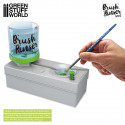
Pre-wetting the brush in clean water before loading paint is the first step toward a successful painting session. By doing this, the bristles become saturated with moisture, creating a hydrophilic barrier that allows the paint to slide out instead of being absorbed inward. It is important to remove excess water so the brush is damp but not dripping, thus maintaining the consistency of the mixture.
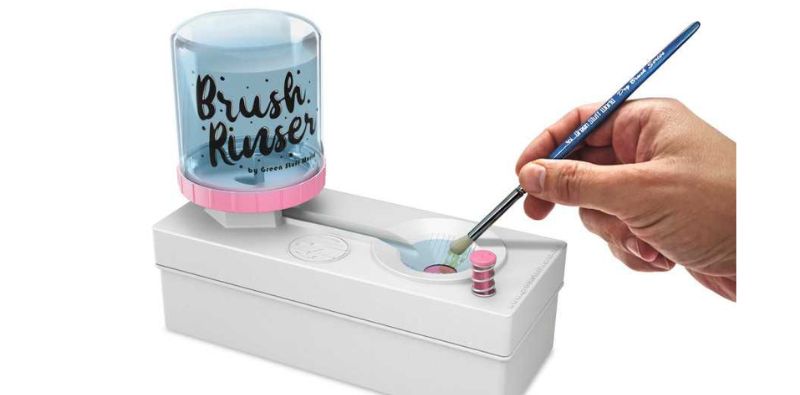
This way, you not only know how to keep model paint wet longer, but you also protect the brush's ferrule. When paint penetrates dry to the base of the bristles, it dries there and spreads the tuft, ruining the tip forever. A properly hydrated brush maintains its shape and ensures that the product flows steadily onto the model's surface, allowing for much longer and more precise strokes.
2. Thin your paints properly
Knowing how to keep model paint wet longer starts with the mixture itself. Acrylic paint for modeling is formulated with a high pigment load and a fast-drying resin. If used pure, the surface-to-volume ratio favors almost immediate evaporation. Thinning not only improves flow but also increases the volume of solvent (water or medium) that must evaporate before the paint solidifies.
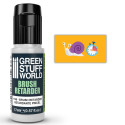
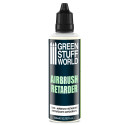
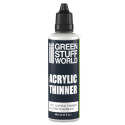
However, adding water is not enough. As we have seen in previous guides, water can break the pigment's cohesion. Using an Acrylic Thinner or a retarder is the professional solution. The retarder works by slowing down the chemical polymerization reaction of the acrylic resin, giving you several extra minutes to paint, although the exact time depends on the amount added and local environmental conditions. It was precisely created to answer what many painters wondered: how to keep model paint wet longer?
It is important to remember that each color range behaves differently. Metallic colors, due to their mica or aluminum particles, tend to dry differently than mattes. Matte tends to dry slightly darker because its white binder becomes transparent; meanwhile, metallic alters its shine and tone, often creating a richer and more vibrant reflective effect. Proper thinning, preferably with mediums that reduce surface tension, ensures that the product stays in an optimal state throughout the base-coating phase.
3. Use a wet palette to keep paint moist
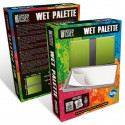
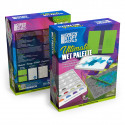
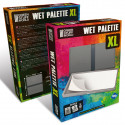
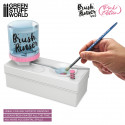
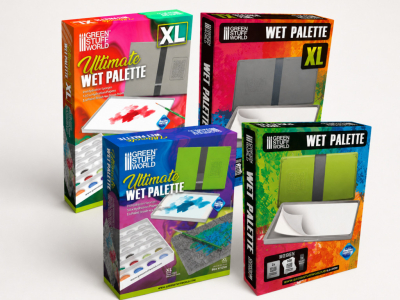
If there is one accessory that has revolutionized modern modeling, it is the wet palette. Its operation is simple yet extraordinary: a hydrophilic sponge keeps a special paper membrane constantly hydrated. Through osmosis, the paint deposited on the paper receives the moisture it loses through top-level evaporation, creating an environment of continuous hydration.
At Green Stuff World, we know that a good wet palette allows your custom mixes to last as long as you need for your projects. This is vital when making custom color blends that are hard to replicate. Imagine painting a bust and having to stop the session; with a hermetically sealed wet palette, you can resume work the next day with the color in the exact same state.
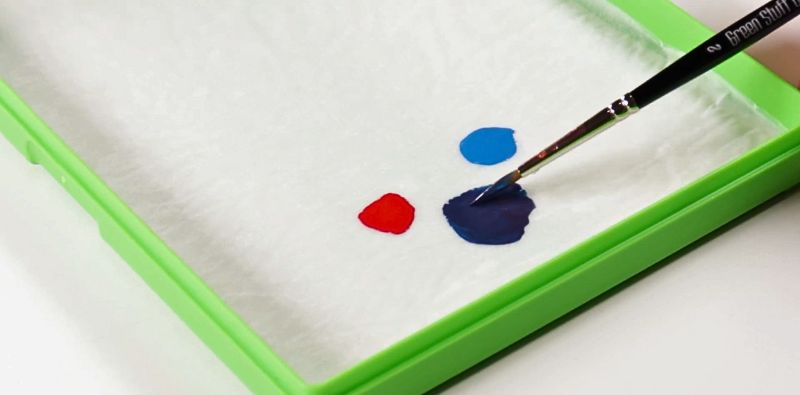
Using a wet palette also eliminates the need to constantly re-thin paint on a plastic palette, which often leads to variations in color transparency. By keeping hydration stable, you guarantee that every brushstroke has the same saturation, which is indispensable for high-competition work or armies with coherent color schemes.
4. Brush size: Why bigger is better
There is a misconception that tiny brushes (000 or smaller) are needed to paint small details. However, the smaller the brush head, the less capacity it has to hold a product load. A size 000 brush has so little volume that the paint dries simply from air contact while you move your hand toward the model.
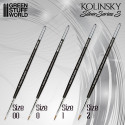
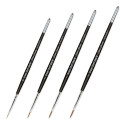
To know how to keep model paint wet longer, use larger brushes! A size 1 or 2 brush with a high-quality sharp tip can perform the same fine detail as a 000 but with a technical advantage: its bristle "reservoir" is much larger. This reservoir acts as a moisture tank that keeps the paint fluid for longer, allowing you to paint eyes, extreme highlights, or edge lining without the tip turning into a dry needle.
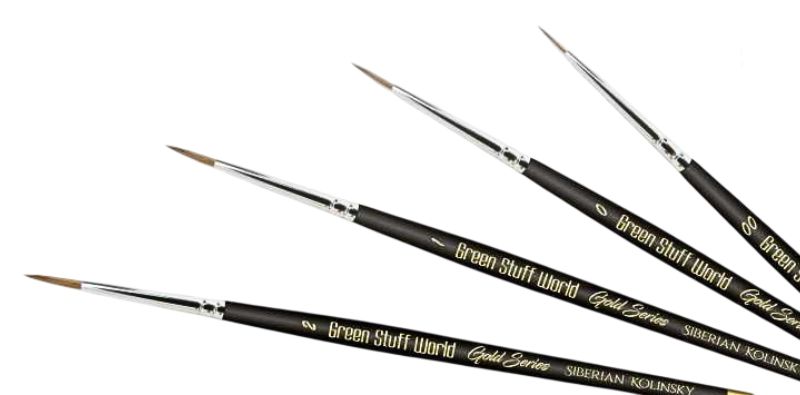
Switching to larger brushes with good loading capacity will transform this reality. You will notice that the color flows with less effort and that you don't need to return to the palette every two seconds. It is a matter of thermal and chemical inertia: the larger the volume of wet paint in the tuft, the slower the proportional evaporation. It is the simplest way of how to keep model paint wet longer.
5. Ambient temperature and relative humidity of your workspace
Environmental conditions are the most ignored factor in modeling. Acrylic paint dries through the evaporation of the water it contains. This evaporation depends directly on the Relative Humidity (RH) and the air temperature in your work area. It is a mistake to think that only heat dries the product; a cold but very dry environment (like in winter with heating) can be just as aggressive.
| Ambient Condition | Effect on Paint | GSW Recommendation |
| High Temp / Low RH | Instant drying on palette and brush. | Mandatory use of retarder and wet palette. |
| Low Temp / Low RH | Fast drying and possible graining. | Constantly pre-wet the brush. |
| High Temp / High RH | Slow drying, ideal for blending. | Watch the waiting times between layers. |
| Low Temp / High RH | Very slow drying, risk of pooling. | You can use a hand dryer (cool air) if necessary. |
Remember that humidity is relative to temperature. Low relative humidity at any temperature will drastically increase drying speed. If you live in a dry area, consider using a humidifier in your hobby zone to maintain a stable environment that favors steady work.
6. The impact of fans and moving air
Moving air is the perfect catalyst for evaporation. A constant flow of air over your palette or brush pulls away water molecules, allowing more to leave the mixture at an accelerated rate. Ceiling or desk fans are the silent culprits behind your paint "breaking" or becoming pasty in seconds.
This is an important tip to share: you must turn off the fan if you are working on fine details. When you use a small brush for lining (like edge highlighting), the amount of paint on the tip is minimal; the airflow from a fan will make it dry almost instantly before it can transfer to the model's surface. Therefore, if you want to know how to keep model paint wet longer, turn off the fan.
If the heat is unbearable, try pointing the fan toward a wall so the air circulates but doesn't hit your workbench directly. Keeping the air static around the palette and the miniature is one of the simplest and most effective ways to prolong the life of your mixes.
7. Other paints and specific cases in modeling
Although acrylics are the kings of the hobby, we cannot forget oil paints and enamels. These paints dry through oxidation rather than water evaporation, which gives them a working time of hours or even days. They are ideal for streaking grime effects or filters on military models, among many others.
However, if you are a loyal acrylic user but need that extra time, the solution is the strategic combination of the previous tips and products:
1. Cleaning: Use brush cleaners that leave the bristles conditioned.
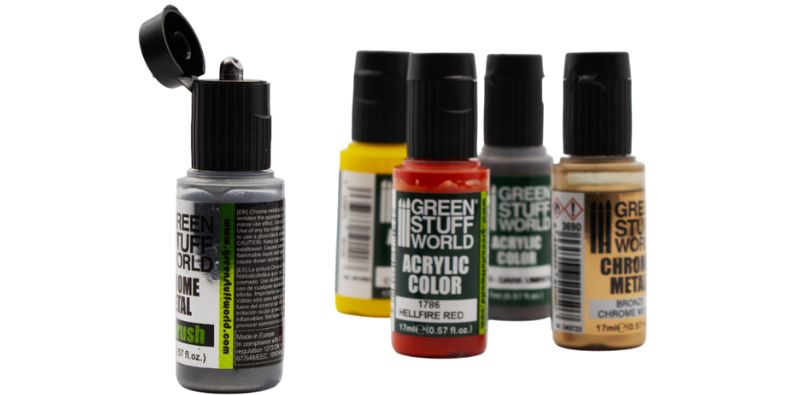
2. Sealing: Keep pots closed while not in use. GSW's "dropper" type bottles are superior to open-cap ones for preventing product degradation.
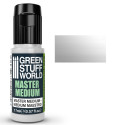
3. Additives: Do not underestimate the power of a good Medium.
Therefore, learning how to keep model paint wet longer is an investment in your progression as an artist. By controlling factors like temperature, airflow, and the tools you use, you reduce the stress of the painting session and allow your creativity to flow without interruptions. At Green Stuff World, we design our tools and products with these technical challenges in mind, ensuring that your only concern is enjoying every brushstroke.
Share this content