


Milliput vs Green Stuff: Which one to choose?
In the world of modeling and in other sculpting disciplines, the choice of the right putty for each project is essential to achieving an optimal result. Two of the most popular among artists are Milliput and Green Stuff. Both are two-part epoxy putties that can be used to fill gaps, build bases, or sculpt details, among many other things.
Despite their shared purpose, the properties, working methods, drying times, and final results differ quite a bit. Furthermore, although both can be used similarly, each is recommended for specific purposes. In this exhaustive Milliput vs Green Stuff comparison, each of their differences is explained so you know which one is most suitable for each of your projects and to help you master the art of sculpting with both putties.
What is Green Stuff?
The term Green Stuff or Green Putty, whose original commercial name is Kneadatite, refers to a two-part epoxy modeling putty that has become the go-to tool for creating fine details on miniatures.
Composition and appearance:
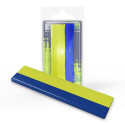
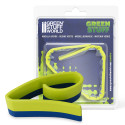
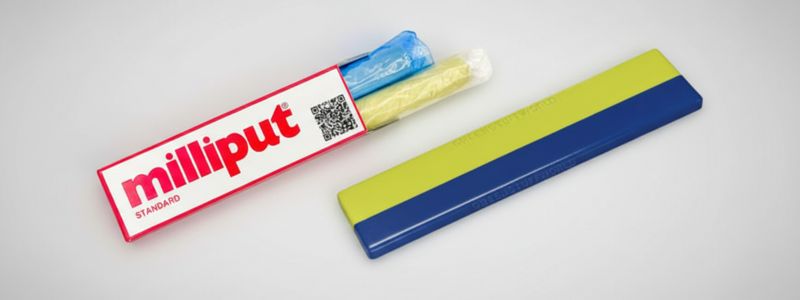
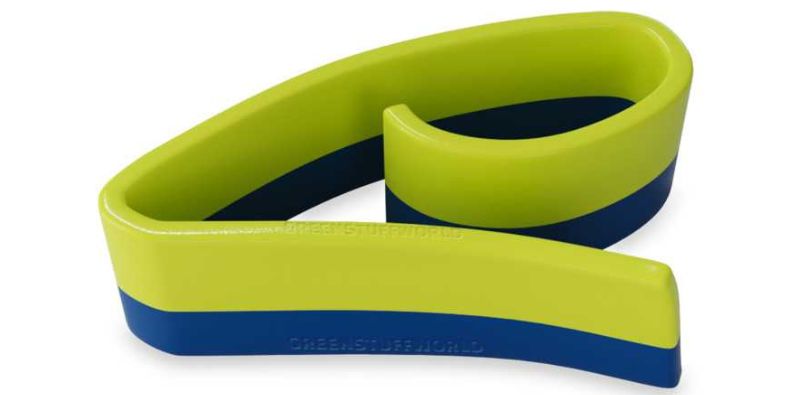
It comes in a two-color strip: blue (the hardening agent) and yellow (the base epoxy resin). It is a putty that cures when mixed, as it generates a chemical reaction.
• Mixing ratio: It is used by cutting and kneading equal amounts of the blue and yellow parts until a uniform green color is obtained. The contrast between both colors is useful for differentiating the parts that are not yet mixed. What is not mixed will not cure.
• Final color: A bright and vibrant light green.
• Working properties: It is notably sticky and elastic. It requires that modeling tools be constantly moistened with water or impregnated with modeling petroleum jelly to prevent the putty from adhering.
Main uses:
Its flexibility and high detail retention make it unsurpassed for:
• Organic sculpture: Sculpting faces, hands, muscles, and complex anatomy.
• Fine details: Creation of hair, beards, horns, or tiny veins.
• Clothing and fabrics: Ideal for simulating the natural drape of cloth, capes, scarves, and uniforms that require movement.
• Repair and conversion: Adding small elements or modifying parts of a plastic or resin miniature.
What is Milliput?
Milliput is also a two-part epoxy putty, but it belongs to a different family of resins with a final result different from that of Kneadatite. It has been a standard in modeling, restoration, and sculpture for decades.
Composition and appearance:
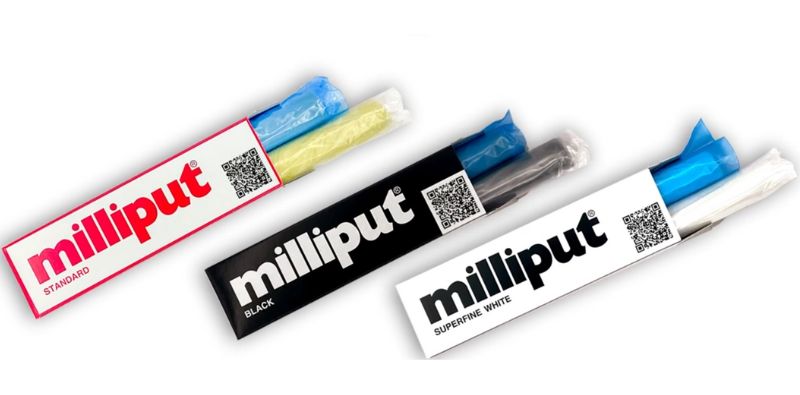
It comes in two separate bars: a resin bar and a hardener (or catalyst) bar. In the same way, it cures by mixing both parts.
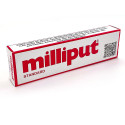
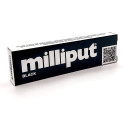
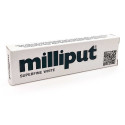
• Varieties: There are several versions of it (Standard Yellow/Grey, Superfine White, Silver Grey, Black, and Terracotta), each with slight differences in its texture and final hardness. Superfine White is the most popular for precision sculpture, as its texture is lighter, although the most well-known is the Standard, which is grittier.
• Mixing ratio: It is cut and kneaded until a uniform color without streaks is obtained. Normally, the same amount of both parts is used, although this ratio can be modified to change its qualities and way of acting.
• Working properties: Unlike Green Stuff, it is less sticky and has a texture more similar to clay or plasticine. It can be kneaded with the fingers and the best way to smooth it is with water, using a wet brush or the wet tools themselves.
Main Uses:
The extreme final hardness and its less rubbery initial texture make it the ideal choice for:
• Structural filling: Filling large gaps, joins, or empty spaces in miniatures and kits.
• Base construction: Creating rock formations, terrain, walls, or scenery elements that require resistance.
• Armatures: Forming the "skeleton" of a sculpture, over which details will be applied with Kneadatite or other putties.
• Machining and finishing: Its hardness allows it to be sanded, drilled, and cut once dry, achieving clean and sharp angles and edges, something almost impossible with Green putty.
Main characteristics: Milliput vs Green Stuff
Next, a comparative table summarizes the essential technical and usage data for each putty.
| Characteristic | Milliput (Poly-epoxide epoxy putty) | Green Stuff (Kneadatite - epoxy putty) |
| Components | Two bars (resin and hardener) | Two strips (Yellow: Resin / Blue: Hardener) |
| Solvent/Lubricant | Water for smoothing and modeling | Water or petroleum jelly for smoothing and modeling |
| Raw texture | Similar to clay/plasticine, less sticky. | Elastic, rubbery, and very sticky |
| Final hardness (cured) | Extremely hard, like stone or ceramic. | Maintains a point of elasticity. |
| Sandability | Excellent (can be sanded, cut, and drilled). | Poor (tends to crumble or peel). |
| Water resistance | It can be modeled with water and is resistant once cured. | It can cure even when submerged in water. |
| Detail retention | Good, perfect for making sharp edges, but tends to be a bit more grainy (depending on the variety). | Excellent, ideal for very fine details, although it is difficult to achieve pointed finishes. |
| Ideal use | Filling, structures, bases, and sharp edges. | Hair, clothes, organic details, moving elements. |
| Cost per gram | Generally, more economical. | More expensive. |
Milliput vs Green Stuff: curing times and properties
The time and way in which these putties dry are key to understanding their functional differences. Both are two-part epoxy putties, which means that curing occurs through an exothermic chemical reaction (it produces heat) and not by evaporation or air drying.
1. Milliput: stony hardness
It is the choice of modelers looking for a material that can be treated like plastic or metal once dry. Its curing is characterized by its slowness and its high-resistance final result.
Curing times (Standard and Superfine):
• Useful working time: Approximately 90 minutes at room temperature (18-22 °C). During this time, the putty is malleable.
• Hardening (dry to the touch): It begins to harden visibly after 2 to 3 hours. At this point, it is best to stop handling it, although depending on the temperature, it can set in about 90 min.
• Full cure: It acquires its maximum hardness and is ready to be sanded, cut, or drilled after 24 hours at normal temperature.
Key drying properties:
• Machinable: Once cured, its texture is very similar to resin or hard plastic. This is vital for creating perfectly straight edges or smooth surfaces by sanding.
• Heat sensitivity: The curing time can be accelerated in warm places since, by curing through an exothermic chemical reaction, heat speeds up the process.
2. Green Stuff: flexibility
It is appreciated for its ability to maintain detailed memory and for its slightly flexible final finish, which offers excellent resistance to impacts or drops of the miniatures.
Curing times:
• Useful working time: Normally a bit more than 90 minutes. The putty stays soft and workable for longer than Milliput, especially if constantly lubricated.
• Hardening (dry to the touch): It begins to dry to the touch after 6–8 hours, depending on the mixing ratio.
• Full cure: Also, it requires 24 hours to reach its maximum durability and point of flexibility.
Key drying properties:
• Flexibility: Even after 24 hours, Kneadatite putty maintains a slight elasticity similar to rigid rubber or hard gum. This flexibility is an advantage for protruding elements of a miniature, such as a fine sword or a cape, as it is less prone to breaking than Milliput.
• Variable ratio: The mixing ratio influences the final result. If, instead of using a 50/50 ratio, unequal percentages of the parts are mixed, different results can be achieved. When the mix contains more blue (hardener), the result will be harder and less flexible. On the other hand, when it contains more yellow (resin), it will be softer and more flexible.
• Heat and cold sensitivity: Heat accelerates curing. Cold or humidity can slow it down. Additionally, if the putty is not well kneaded or an incorrect ratio is used, it can remain sticky indefinitely.
Functional differences: summary
For a modeler, the decision between Milliput vs Green Stuff can be reduced to these three functional differences:
| Aspect | Milliput | Green Stuff |
| Hardness/Flexibility | Hard cure (like stone). | Flexible cure (like rubber). |
| Post-cured work | It can be sanded and drilled. | It cannot be sanded or drilled effectively. |
| Wet work | Smoothed with water. | Smoothed with water, petroleum jelly, or special tools to prevent sticking. |
The Magic of the mix: "Mixie-Put"
Many professional sculptors, instead of facing Milliput vs Green Stuff, combine the best of both worlds by mixing both epoxy resins in equal proportions. The result is a putty that has the structural strength of Milliput, but the high detail retention of Kneadatite in addition to reducing its stickiness. This mixture cures with an intermediate hardness, as it is hard enough to maintain its shape but flexible enough to resist small impacts without cracking.
How much does Milliput vs Green Stuff cost? Price comparison
The price comparison can be a turning point when choosing the supplier for your modeling products. There are many online stores and businesses that stock both, but not all have the same offers.
Both Milliput and Green Stuff sell wholesale, so they can only be purchased through businesses that have these references in their catalogs. It must be taken into account that the price can vary depending on the format of each product. Regarding Milliput, although it is only sold in 113.4-gram formats, there are several types, and they do not all cost the same. That is why its price can change depending on both the type purchased and the company from which it is acquired. On our website, we sell three of the five types of this epoxy putty, whose prices range between €5.10 and €8.03. On Amazon, you can find the 5 varieties of it, with prices that fluctuate between €6.29 and €14.50.
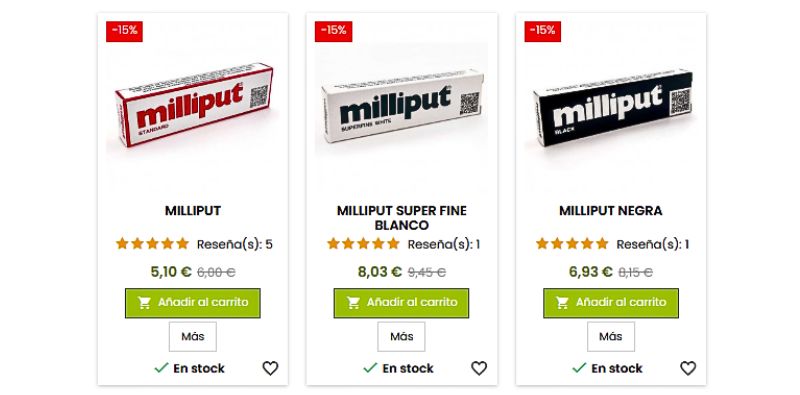
Price of the different Milliput varieties at Green Stuff World
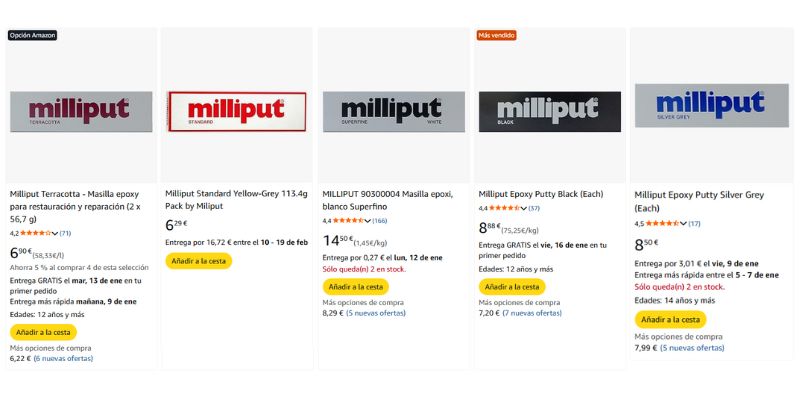
Price of the different Milliput varieties on Amazon
| Milliput (113,4g 4 ~ 4oz) | Green Stuff World | Amazon |
| Standard | 5,10€ | 6,29€ |
| Superfine White | 8,03€ | 14.5€ |
| Black | 6,93€ | 8.88€ |
| Terracotta | - | 6.90€ |
| Silver Grey | - | 8.50€ |
On the other hand, for Kneadatite, one can only choose the amount of product sold, so it is easier to compare this putty by price per gram, per centimeter, or per inch. At Green Stuff World, the cheapest product per inch is the 92 cm (36.5 inches) green putty, whose price would be €0.19/cm (€0.47/inch). On Amazon, the cheapest seller offers 10 cm (4 inches) of Kneadatite for €0.61/cm (€3.06/inch).
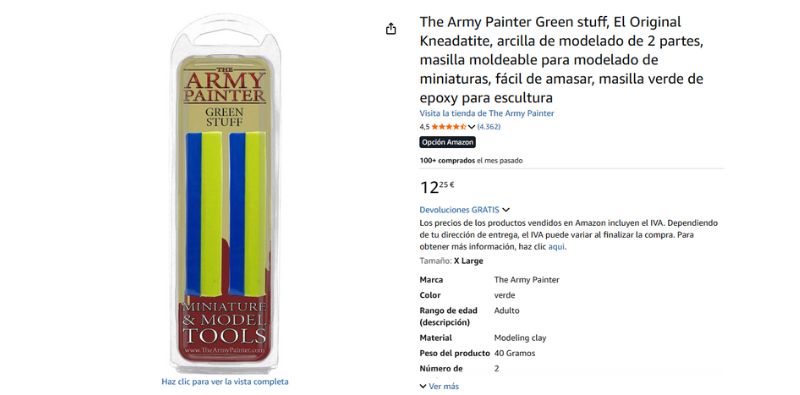
Price of Green Stuff on Amazon
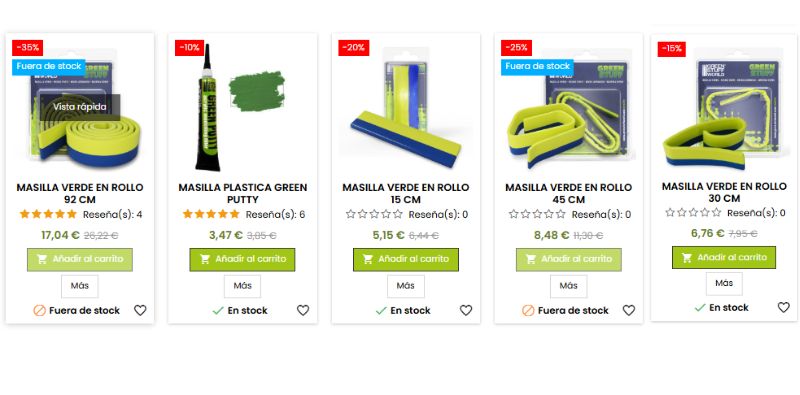
Price of the various Green Stuff products at Green Stuff World
To compare which two-part putty is cheaper Milliput vs Green Stuff, we will calculate the price per ounce (28.35 g) of both products. As a reference, we will use the lowest prices for each of them.
| Putty | Price per ounce (28.35 g) |
| Milliput (standad) | 1,30 € |
| Kneadatite | 3,40 € |
Therefore, if a project requires a large amount of putty for structural filling (base, terrain), Milliput is, without a doubt, the most cost-effective option. If only fine details and small touches are needed, the higher cost of Kneadatite is acceptable. One must also take into account the necessary finish and the molding detail, as explained previously, as they do not give the same results. Of course, if price is not an issue for the artist, they will only have to look at the modeling and curing characteristics that are most convenient for the project.
Where to buy Milliput and Green Stuff?
Both can be purchased in specialized hobby stores, although not all sell the putties at the same price. Green Stuff World is one of the stores with the best offers throughout the year, so your purchases will be more cost-effective. You can buy the products from the catalog both on its official website and on its profile within the Etsy and eBay e-commerce platforms. It also has a large number of reseller stores spread throughout the world, where you can find the vast majority of its items.
Additionally, it has several versions of each of these products. Kneadatite is sold in different quantities, as well as in a more liquid plastic putty format, perfect for repairing small cracks and filling gaps and holes in a miniature or diorama. Regarding Milliput, three models are sold: original, superfine white, and black. Each of them has small differences that provide projects with what they need at any given time.
Pros and Cons: Milliput vs Green Stuff World
To help you make a final decision, here is a breakdown of the advantages and disadvantages of each material.
Pros
• Detailed modeling: Milliput is perfect for designs with sharp edges and right angles, while Kneadatite allows for capturing fine details.
• Extensive working time: these putties can be worked for between 1.5 and 2.5 hours, depending on environmental conditions, enough to model what you need.
• Choice of mix: putty properties can be adjusted by changing mixing ratios—that is, using more resin or hardener. Likewise, both two-part putties can be mixed to change their qualities, ways of acting, and finishes.
• Green Stuff: the finish of this product has a certain flexibility, so its resistance to impacts will be greater than that harden stone-hard. To this, it must be added that its rubbery texture facilitates the creation of smooth organic transitions and curves.
• Milliput: It cures with extreme hardness that allows modeling shapes with very straight and sharp edges. Consequently, it can be sanded, drilled, cut, and polished to achieve perfect geometries. Additionally, to model or smooth it, you only need water and a brush or sculpting tools. Finally, one of the greatest attractions for artists who sculpt or use putty often is its price, much more economical than most putties on the market.
Cons
• Slow curing: although Kneadatite is dry to the touch in 6 hours, the full cure of both is not complete until after 24 hours.
• Texture: Green Stuff is difficult to work with without moistening or using petroleum jelly on tools due to its extreme stickiness. In contrast, Milliput's texture is slightly grainy, especially the Standard, which makes it difficult to capture very fine details.
• Green Stuff: its flexible finish prevents any machining or post-cure correction with sandpaper, cutters, etc. On the other hand, its price is very high, which leads many artists to look for alternatives.
• Milliput: a disadvantage of this putty, just as it is an advantage, is its hardness, which implies a greater risk of breakage compared to more flexible ones. Likewise, if not properly moistened, it can become difficult to work with, drying out too quickly.
So, is it better to use Milliput or Green Stuff?
It is not a matter of having a favorite or one product being better than the other when comparing Milliput vs Green Stuff; the choice depends on the context, and they can be complementary. You can choose Milliput if you need to build a solid structure with polyhedral shapes, fill, sand... or if your budget for materials is low. Conversely, you can choose Kneadatite if you need to render fine and precise details or fluid and organic shapes.
Another option, for advanced sculptors or those who want to try new textures and finishes, is to use a mixture of both or use them in different phases of the creation process: use Milliput to create the general shape and volume (the "skeleton"), and then use Kneadatite to add the final layer of detail, folds, and textures.
In the end, by understanding the unique properties of each, it is possible to transform the creative modeling process, ensuring a better result in each project. In this way, it is not necessary to pit Milliput vs Green Stuff but, on the contrary, use them in a complementary way.
Share this content