


What is Gundam?

If you've heard the name a thousand times but still don't know exactly what is Gundam, pay attention because we explain everything in this article. More than just a simple anime series, Gundam is one of the most influential, long-lasting, and complex science fiction franchises in history, a saga that redefined the "mecha" genre (giant human-controlled robots) by injecting political realism, deep social themes, and the human drama of war.
Over more than four decades, the franchise has generated multiple television series, movies, manga, novels, and, perhaps most iconic, the famous plastic model kits known as Gunpla. Of course, they also have their 3D printed resin version. But let's start at the beginning.
What is a Gundam?
A Gundam is a specific type of "Mobile Suit." Mobile Suits are giant humanoid combat vehicles, often bipedal, that serve as the primary weapon of war in this universe.
This term is generally used to designate the most advanced, powerful, or experimental Mobile Suits of a faction, often piloted by the protagonist of a series. They are distinguished from other suits by several characteristics:
• Cutting-Edge Design: They usually have a more complex and distinctive design than standard or mass-produced Mobile Suits like the Zaku or Jesta.
• Superior Combat Capability: They are equipped with the most advanced technology, including experimental weaponry, high-performance propulsion systems, and more resistant armor.
• Characteristic Appearance: Many iconic Gundams share a visual pattern: a primary color scheme (white, blue, red, and yellow), a pair of "V-antennas" or "fins" on the head, and a face that often resembles a mask with twin "eyes."
In essence, while a Mobile Suit is a humanoid tank, the Gundam is the experimental prototype, the elite war machine that often marks a turning point in the conflict the story portrays.
What does the word "Gundam" mean?
Although you already know what is Gundam, the meaning of the word itself has an interesting history dating back to its creator, Yoshiyuki Tomino, and the production team at Sunrise studio.
Originally, the concept for the series had a different working title, "Gunboy," which was formed by combining the word "gun" (because the character was armed with this weapon) and "boy," as the series was aimed at a shōnen audience ("boy" in Japanese and English). However, Tomino opted for a name that would suggest a blend of offensive power and impregnable defense. The most accepted explanation for the name's origin is that it is an acronym or a fusion of two English words:
• "Gun": Referring to the fact that the protagonist was a machine armed with a gun.
• "Dam": Suggesting that the machine is strong enough to "contain" or "stop" enemy forces, like a dam stops a flood.
Thus, Gundam connotes a machine with the power of a gun but the defensive and containment capacity of a dam, representing a Mobile Suit designed to protect and dominate the battlefield.
When did it Premiere?
The franchise "Mobile Suit Gundam" or MSG (Kidō Senshi Gandamu) made its debut on Japanese television screens on April 7, 1979.

This original series, despite a modest initial reception that led to its number of episodes being reduced, would become a massive cultural phenomenon thanks to subsequent reruns and, above all, the launch of the Gunpla model kits.
This debut marked the beginning of the franchise's main timeline, known as the Universal Century (UC), and laid the groundwork for all the series and alternative universes that would follow.
How tall are Gundams?
The size of one of these robots is one of the most striking characteristics and a key factor in its visual impact.
The standard size of one of these Mobile Suits in the Universal Century (UC) timeline, which includes the iconic RX-78-2 Gundam from the original series, is approximately 18 meters (59 feet) in height.
To put this in perspective:
• 18 meters is roughly the height of a six- or seven-story building.
• The life-size RX-78-2 exhibited in Yokohama measured 18 meters in height (with the addition of the optional propulsion wing, some Mobile Suits can exceed 20 meters).
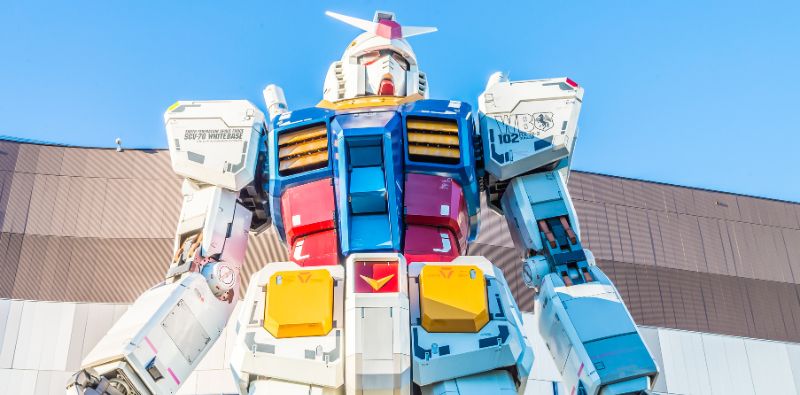
However, the height of these robots varies significantly among the franchise's different timelines. Initially, in the UC timeline, they measured around 18 meters, while later in the same timeline, such as in F97 or Victory Gundam, Mobile Suits become considerably smaller, dropping to about 15 meters or less, a change driven by resource limitations and technological advancements enabling miniaturization.
On the other hand, in Alternative Universes (AU), sizes vary. For example, the original Wing is around 16.3 meters, while the Nu Gundam (UC) is one of the largest at almost 22 meters. In general, robots come in many sizes, depending on the anime.
How do characters control a Gundam?
Piloting a Mobile Suit is a blend of advanced technology and human skill, varying slightly between different series but generally involving a sophisticated control system:
• Panoramic Cockpit: Most advanced robots, especially in the Universal Century, use a spherical cockpit with a 360-degree display that offers the pilot a complete view of the exterior.
• Dual-Lever Controls (Joysticks): Movement of the torso, arms, and hand weaponry is controlled via two control sticks (one in each hand). These levers typically have multiple triggers and buttons for primary and secondary weapons.
• Pedals/Foot Controls: Pedals on the floor or foot controls are used to direct leg movement, Mobile Suit orientation, and the control of thrusters for movement in space or jump boost.
• Brain Interface Systems (Newtypes): In the Universal Century timeline, the concept of Newtypes is introduced—a type of evolved human with enhanced psychic abilities. Mobile Suits designed for Newtypes, such as the Nu Gundam or the Unicorn, employ systems like Psycommu or Psycho-Frame, which allow the pilot to control remote weapons (like Fin Funnels) or even maneuver the suit through the power of thought or the extension of their emotions, making the interface more intuitive and reactive than simple mechanical control.
How many Gundam series are there?
Counting the exact number of series in this universe can be complicated due to the vast amount of content that includes television series, OVAs (Original Video Animations), movies, web series, and spin-offs.
However, the franchise can be divided into two large groups of timelines:
1. Universal Century (UC)
This is the original and central timeline, starting with Mobile Suit Gundam in 1979. Most of the most important works are set here, exploring a continuous history of war, politics, and human evolution through Newtypes.
• Main UC Series: MSG (0079), MSG Zeta, MSG ZZ, MSG Victory.
• Key UC OVAs and Movies: Char's Counterattack, 0080: War in the Pocket, Gundam 08th MS Team, 0083: Stardust Memory, Unicorn, Gundam Narrative, Hathaway's Flash.
2. Alternative Universes (AU)
These are series that tell completely self-contained stories in different timelines, making them ideal for newcomers. These series have their own technologies, conflicts, and often a distinct tone. The most relevant are:
• Future Century (FC): Mobile Fighter G Gundam, a martial arts and tournament focus.
• After Colony (AC): MSG Wing, popular in the West, with a focus on sabotage missions and heroism.
• Cosmic Era (CE): MSG SEED and SEED Destiny explore the conflict between genetically engineered and natural humans.
• Anno Domini (AD): MSG 00 focuses on a private organization's intervention to stop global wars.
• Post-Disaster (PD): MSG: Iron-Blooded Orphans, a cruder vision centered on fraternal bonds.
• Ad Stella (AS): MSG: The Witch from Mercury, the most recent, focusing on education, corporate politics, and GUND technology.
Adding up all the main TV series, OVAs, and relevant movies from both categories, the franchise has over 30 major titles and continues to grow.
How to watch Gundam in order?
Due to the existence of the continuous timeline and the many independent Alternative Universes, the question of how to watch Gundam in order has two main answers:
1. Universal Century (UC) Viewing Order
If you want to experience the central narrative, you must follow the chronological order of UC events. This is the longer path but the most rewarding for die-hard fans:
• MSG (0079): The original series (or its three compilation films that summarize the main story).
• Mobile Suit Zeta Gundam
• MSG ZZ
• MSG: Char's Counterattack (Movie)
• MSG Unicorn (OVA or TV series)
• MSG Narrative (Movie)
• MSG: Hathaway's Flash (Movie)
• UC Secondary OVAs and Series: These can be watched as complements at the point in the chronology where they occur, for example:
• MSG 0080: War in the Pocket (during the One Year War, UC 0079)
• MSG: The 08th MS Team (during the One Year War, UC 0079)
• MSG 0083: Stardust Memory (between 0079 and Zeta)
2. Beginner (AU) Viewing Order
If you are new to the franchise and want a self-contained story without needing to know the prior history, you can start with almost any Alternative Universe. These are the highly recommended series for this purpose:
• MSG: The Witch from Mercury (Ad Stella): It is the most recent, with modern production and a starting story that requires no prior Gundam knowledge.
• MSG SEED (Cosmic Era): A good modern reboot of the classic format with vibrant graphics.
• MSG 00 (Anno Domini): A futuristic story that feels more global and contemporary.
• MSG: Iron-Blooded Orphans (Post-Disaster): A "low-level" narrative with visceral battles and a focus on character bonds.
Regardless of the chronological order, you can always watch all the content from this universe in the release order, as it will be well understood, just as the people who have seen every movie, series, and OVA in the order of publication understood it.
What is Gunpla?
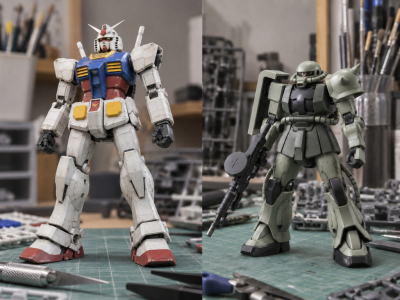
Gunpla is the abbreviation for Gundam Plastic Model. They are scale model kits of the Mobile Suits and other machines from the franchise, manufactured by the Japanese company Bandai since 1980.
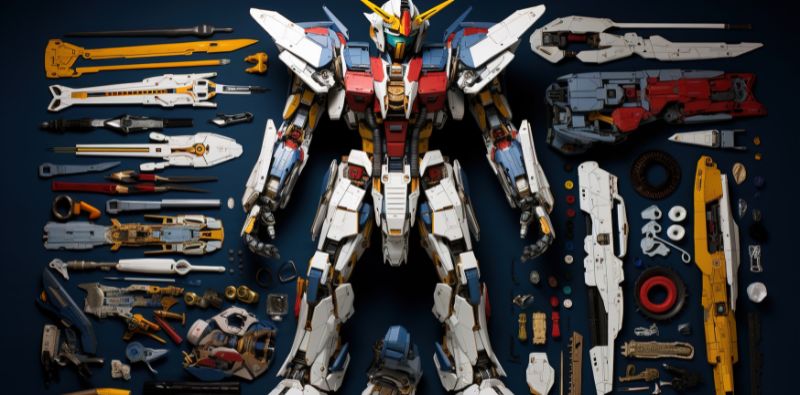
Gunpla plastic models are distinguished from traditional ones for three essential reasons. First, they use Snap-Fit packaging, meaning no glue is required. Modern kits are designed to fit together perfectly without the need for adhesive, making them accessible to modelers of all levels. Second, the pieces are pre-colored with the corresponding colors, allowing the model to look good even without paint. Finally, Gunpla are articulated and can imitate the dynamic poses from the anime series.
Gunpla Grades
The kits are classified into "grades" that indicate the scale, level of detail, complexity, and cost. Some of the most common grades are:
| Grade | Scale | Detail and Complexity Level |
|---|---|---|
| Entry Grade (EG) | 1/144 | Entry level, very simple, few parts. |
| High Grade (HG) | 1/144 | The hobby standard. Good detail, quick build, affordable. |
| Real Grade (RG) | 1/144 | Highly detailed, with a pre-assembled "internal skeleton." Complex. |
| Master Grade (MG) | 1/100 | Great internal and external detail, highly poseable. The favorite of experienced modelers. |
| Perfect Grade (PG) | 1/60 | The pinnacle of Gunpla technology. Maximum detail, very complex parts, often featuring electronics (LED lights). |
Where to buy Gunpla?
The global popularity of Gunpla means there are multiple places to acquire kits:
• Specialized Hobby and Modeling Stores: These are the best option, as they usually have a wider stock, the latest releases, and knowledgeable staff.
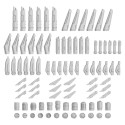
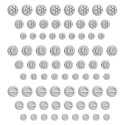
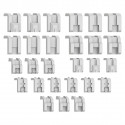
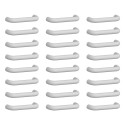
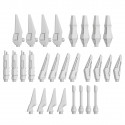
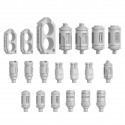
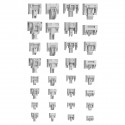
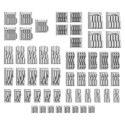
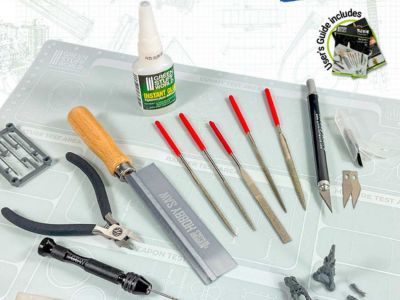
• Green Stuff World: At Green Stuff World, we have a great variety of mecha detail parts kits to add details and customize your Gunpla. They are printed in high-quality resin to make them durable and with unbeatable precision. You can purchase everything from accessories for TAU combat suits to panels and rivets of all types. Additionally, you can complement it with all the products you need to give it the best finish: glues, model paints, paint brushes, varnishes, etc.
• Comic and Collectibles Stores: Many stores that sell anime figures, manga, or comics also have a section dedicated to Gunpla.
• Department Stores or Large Toy Stores: Occasionally, especially in large cities, the toy or collectibles sections may carry HG or MG level kits.
• Specialist Online Stores: Websites and specialist stores in this sector offer the largest selection and the possibility of finding hard-to-get kits (or pre-orders), many with international shipping.
• General E-commerce Platforms (Amazon, eBay): While convenient, prices and availability can vary drastically, and you must be careful with resellers.
Where to Watch Gundam?
Fortunately, the distribution of the franchise has improved significantly, making watching Gundam easier than ever:
• Crunchyroll and Funimation (or Hulu): These have historically been the main platforms for most of the Universal Century and Alternative Universe TV series, including MSG Wing, MSG SEED, MSG 00, and the Build Fighters series.
• Netflix: Has acquired the rights to several major films and key series, although depending on the country from which you subscribe to Netflix, you will be able to access one content or another related to this universe.
• YouTube (GundamInfo): Gundam's official YouTube channel often offers select series or episodes for free (with subtitles) for limited periods, or even full Alternative Universe series, among others.
Has the Gundam Metaverse Failed?
The franchise's most recent foray into the "metaverse" concept was through the miniseries Gundam Build Metaverse, launched to commemorate the 10th anniversary of the Gundam Build sub-franchise.
It is a new anime series that explores an online gaming environment where Gunpla modelers battle with digital versions of their models, a concept introduced in earlier series like Gundam Build Divers.

The three-episode miniseries has not been a commercial "failure" affecting the entire franchise, but it has received negative reviews from the fan community for several reasons. It has been reiterated that three episodes are too short a runtime to develop a significant plot or characters. Furthermore, the theme was perceived as very corporate, asserting that it felt more like a "Gunpla commercial" with little heart than a new series within the universe, a sentiment that did not appear in other series like Build Fighters. Similarly, the "metaverse" or online gaming concept was criticized for being unoriginal compared to the fantastical elements of earlier series (like Plavsky particles).
In online forums, many followers of this universe have also criticized the nonsense of the characters' ages, a lack of depth in the story, a drop in animation quality, and cameos by characters from other series that break the dynamic of the episode's story.
For all these reasons, this miniseries was seen by many as a creative disappointment within the Gundam Build saga, but it does not represent a failure of the Gundam "metaverse" as a global product. The success of the franchise continues to be driven by traditional anime series and, of course, the constant and successful sale of Gunpla.
In the end, to know what is Gundam, it is necessary to know all facets of this universe of mobile robots: the plots and characters of its anime, the philosophical reflections behind it, and all the fanaticism it has created off-screen, including the Gunpla kits.
Share this content